
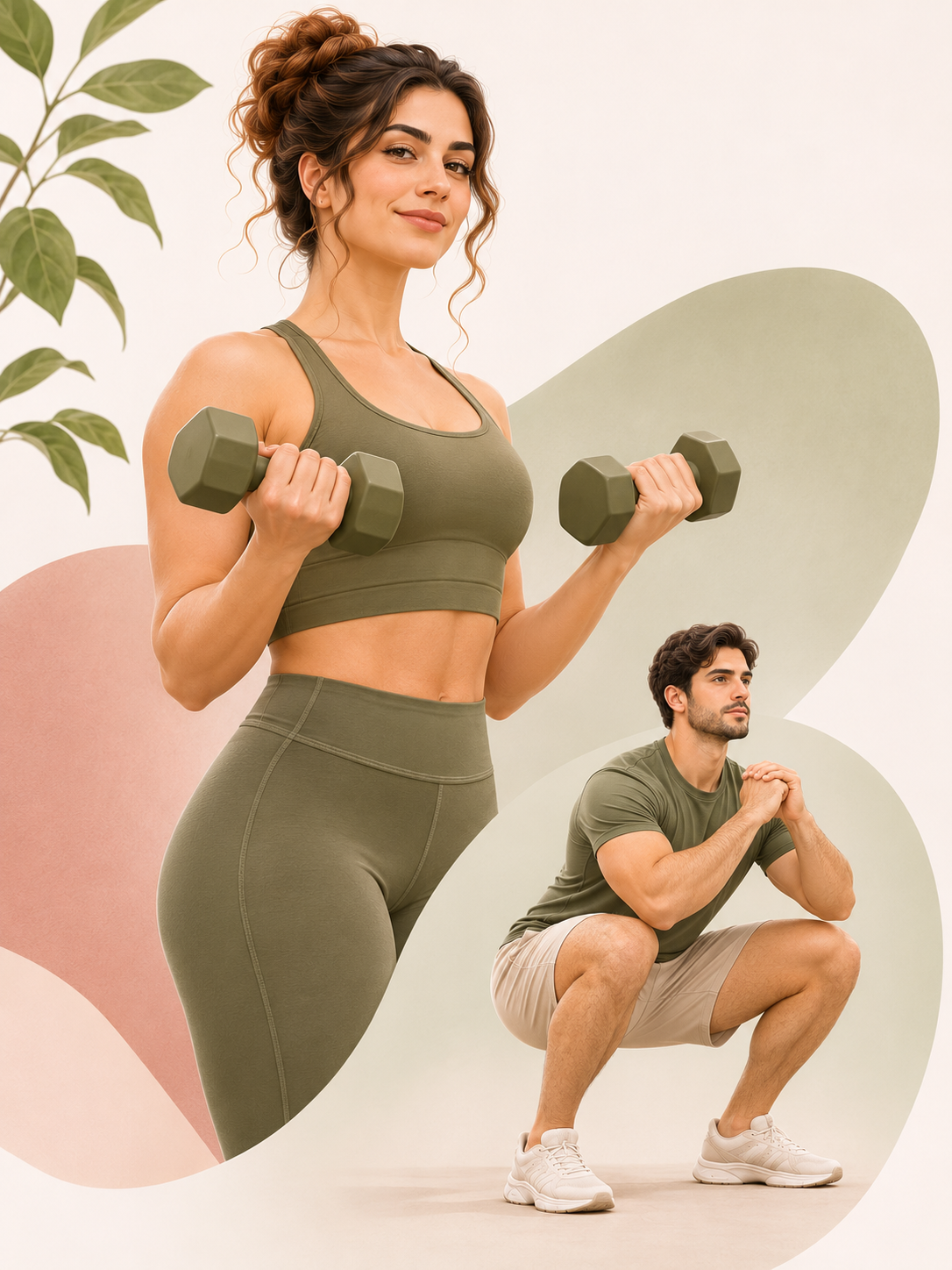
Starting strength training can feel intimidating when you are unfamiliar with dumbbells, gym machines or exercise techniques. You might wonder which exercises to try, how much weight to lift, or how often you should train.
The good news is that you do not need an expensive gym membership, heavy weights or an advanced workout routine to begin building strength.
Strength training for beginners is about learning controlled movements, gradually challenging your muscles and developing a routine you can maintain.
You can start with bodyweight exercises at home, use resistance bands, practise with light dumbbells or work with gym machines. What matters most is choosing suitable exercises, learning correct technique and progressing gradually.
In this guide, you will learn what strength training is, why it matters, which beginner exercises target different muscle groups, how to perform them correctly and how to follow a simple weekly strength training plan.
What Is Strength Training?
Strength training, also called resistance training or weight training, is a type of physical activity in which your muscles work against resistance.
That resistance can come from:
- Your own body weight.
- Dumbbells and barbells.
- Resistance bands.
- Weight machines.
- Kettlebells.
- Other external loads.
When you perform a resistance exercise, your muscles produce force to move or control the resistance. With consistent training and appropriate recovery, your body can adapt by improving muscular strength and other aspects of physical fitness.
For example, when you perform a squat, your legs and hips work to lower and raise your body. During a push-up, your chest, shoulders and arms help move your body away from the floor.
Strength training is not exclusively about building large muscles. It can also help improve physical function, muscular endurance and your ability to perform everyday activities.
Strength Training vs Weight Training
The terms are often used interchangeably, but they are not exactly identical.
| Term | Meaning |
|---|---|
| Strength training | A broad term for exercises that challenge muscles against resistance |
| Weight training | Strength training using dumbbells, barbells or machines |
| Resistance training | Training against any form of resistance, including bands and bodyweight |
| Bodyweight training | Exercises using your own body as resistance |
You can begin strength training without lifting traditional weights. Bodyweight squats, wall push-ups and resistance-band exercises are all useful starting options.
What Are the Benefits of Strength Training?
Regular strength training can support several aspects of physical health and fitness. The benefits develop over time, and individual results vary depending on training consistency, recovery, nutrition and other factors.
1. Builds Muscular Strength
One of the main benefits of resistance training is improved muscular strength.
Exercises such as squats, rows, presses and lunges challenge different muscle groups. As your body adapts, movements that initially feel difficult may become easier.
Improved strength can help with everyday activities such as:
- Carrying shopping bags.
- Climbing stairs.
- Getting up from a chair.
- Lifting household objects.
- Carrying luggage.
- Maintaining physical independence.
2. Supports Muscle Development
Strength training stimulates the muscles to adapt to repeated resistance.
With consistent training, adequate nutrition and recovery, resistance exercise can increase muscle size, a process known as muscle hypertrophy.
Beginners can often make noticeable improvements in strength as they learn exercise techniques and become more coordinated.
However, muscle growth takes time. It is not necessary to lift extremely heavy weights or train to exhaustion to begin making progress.
3. Supports Bone Health
Resistance exercises place mechanical demands on muscles and bones.
Weight-bearing and muscle-strengthening activities can support bone health and help maintain physical function as people age.
Exercises such as squats, step-ups and resistance training can be useful components of an overall activity programme.
People with osteoporosis, previous fractures or other bone-related conditions should obtain appropriate professional advice before starting a new programme.
4. Supports Weight Management
Strength training can contribute to weight management by increasing physical activity and helping maintain or develop lean muscle mass.
Muscle tissue requires energy, but the effect of increased muscle mass on daily calorie expenditure should not be exaggerated.
For people trying to manage their weight, resistance training works best as part of a broader approach that includes balanced nutrition, aerobic activity, sleep and sustainable habits.
Important: Strength training cannot selectively remove fat from the stomach, arms, thighs or another specific body part.
5. Improves Functional Fitness
Functional strength is the ability to use your muscles effectively during everyday movements.
Training your legs, hips, back, chest, shoulders and core can help you develop the strength and control required for routine activities.
For example, a squat strengthens muscles involved in sitting and standing, while a row develops muscles used during pulling movements.
6. Supports Mental Well-Being
Physical activity can support mental well-being, and some people find strength training helps them feel more confident, capable and motivated.
Completing manageable workouts can also create a sense of routine and accomplishment.
Exercise is not a replacement for professional treatment for mental health conditions.
7. Helps Maintain Strength as You Age
Muscle strength and physical function can change with age.
Regular resistance training is one way to maintain muscle strength, mobility and independence.
A beginner programme can be adapted to different ages and abilities, including chair-supported exercises when appropriate.
The World Health Organization and UK physical activity guidance recommend muscle-strengthening activity involving the major muscle groups on at least two days each week.
Which Muscles Does Strength Training Target?
Before choosing exercises, it helps to understand the major muscle groups.
A balanced strength training routine should work the major areas of the body rather than repeatedly training only the arms, stomach or legs.
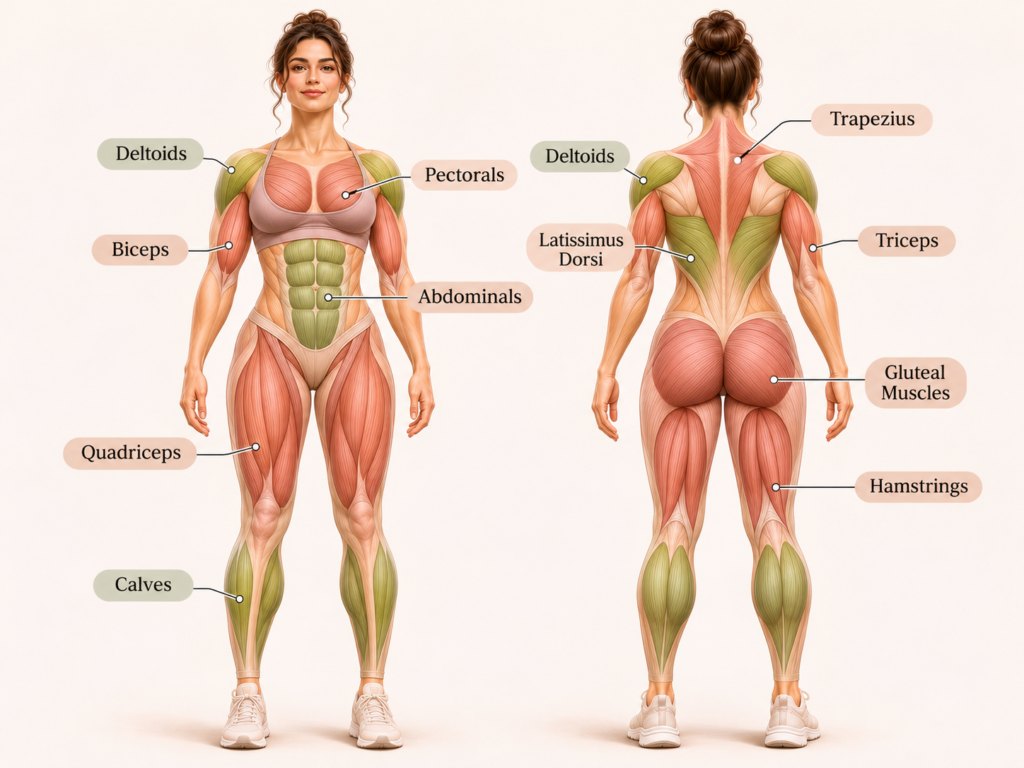
The major muscle groups include:
| Muscle group | Main function | Example exercises |
|---|---|---|
| Chest (pectorals) | Pushing movements | Push-ups, chest press |
| Back (latissimus dorsi, trapezius and others) | Pulling and posture support | Rows, lat pulldowns |
| Shoulders (deltoids) | Arm movement and lifting | Shoulder press |
| Biceps | Bending the elbow | Biceps curls |
| Triceps | Straightening the elbow | Triceps extensions |
| Quadriceps | Straightening the knee | Squats, step-ups |
| Hamstrings | Bending the knee and assisting hip extension | Hip hinges, bridges |
| Gluteal muscles | Hip extension and stabilisation | Squats, glute bridges |
| Calves | Ankle movement | Calf raises |
| Core muscles | Trunk stability and movement control | Planks, dead bugs |
A well-designed beginner programme should include pushing, pulling, squatting, hip-hinging and core-stability movements.
Best Strength Training Exercises for Beginners
You do not need dozens of exercises to build a useful beginner routine.
Start with a small selection of movements that cover the major muscle groups. Learn the technique first, then gradually increase the challenge.
The following exercises can be adapted for home or gym training.
1. Bodyweight Squats
Primary muscles targeted: Quadriceps and gluteus maximus.
Secondary muscles: Hamstrings, adductor muscles and core stabilisers.
Equipment: None. A stable chair can be used for assistance.
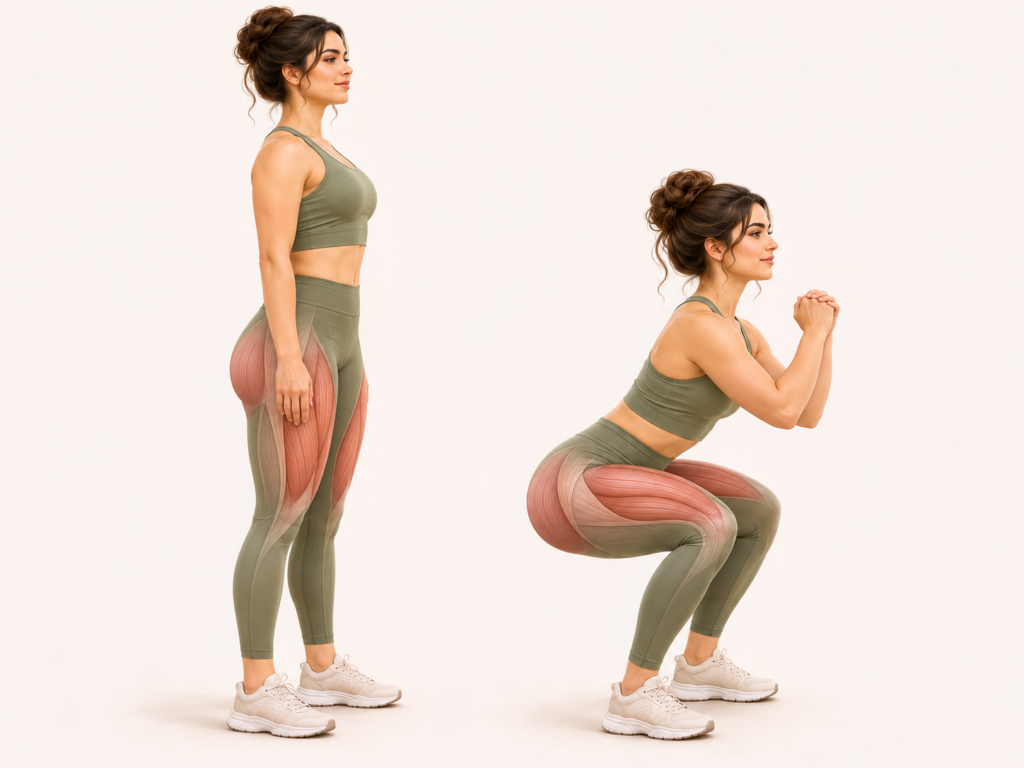
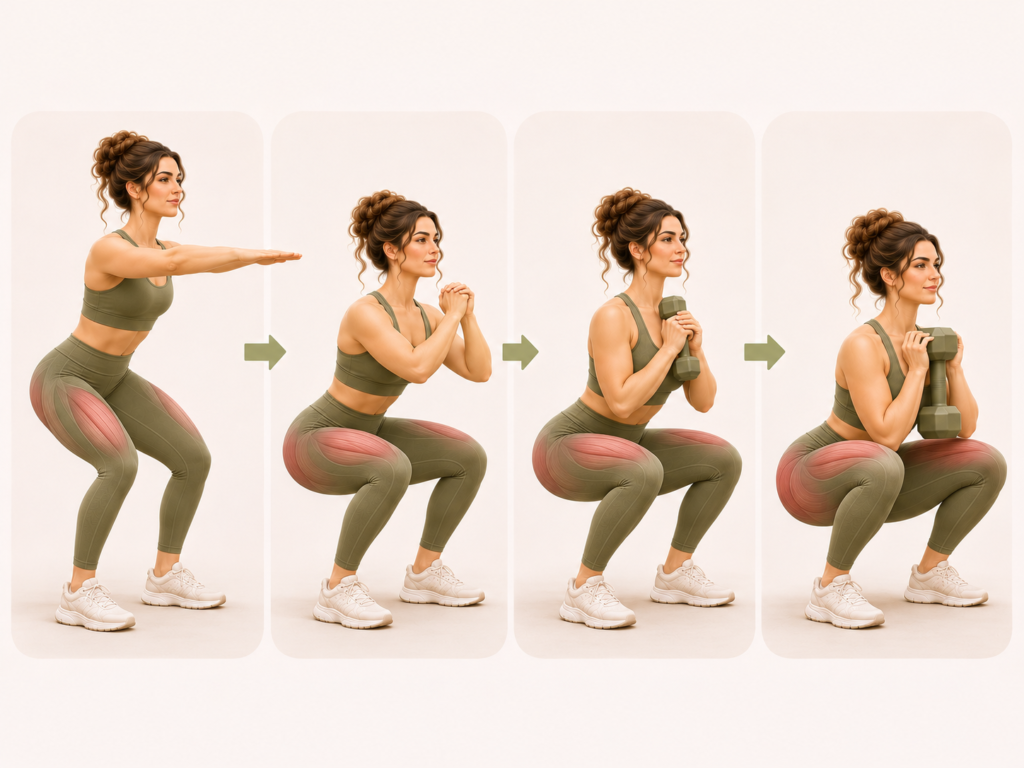
How to perform a bodyweight squat:
- Stand with your feet approximately shoulder-width apart.
- Keep your toes pointing slightly outward if that feels natural.
- Brace your abdomen gently.
- Push your hips backwards as you bend your knees.
- Lower yourself only as far as you can comfortably control.
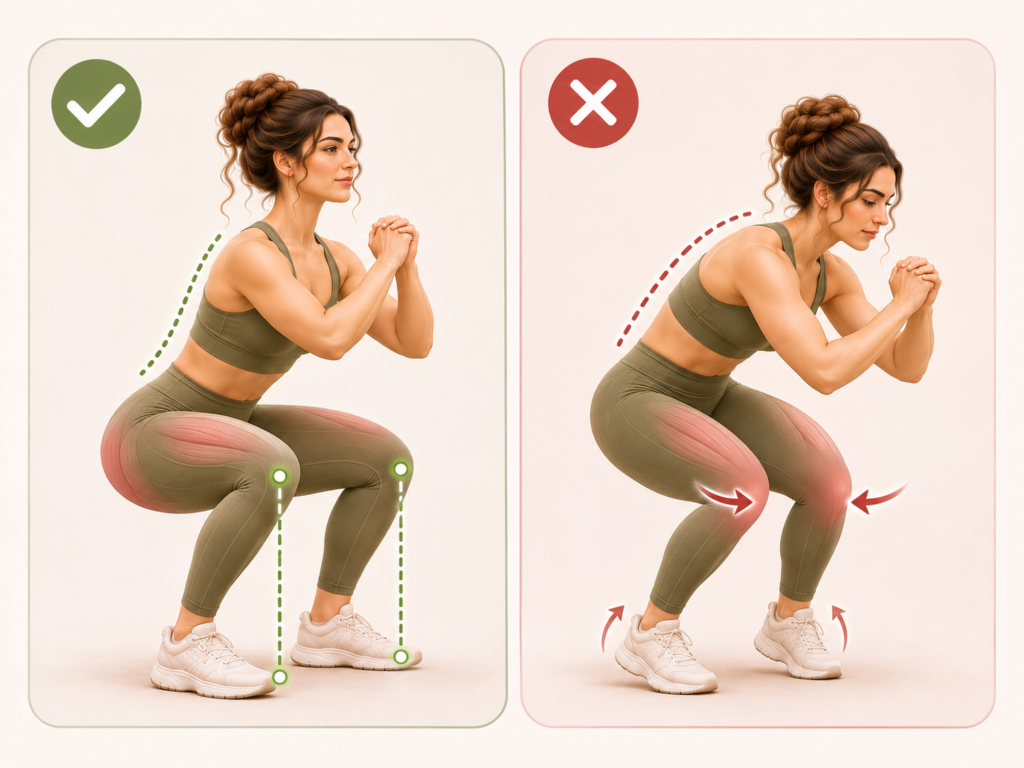
- Keep your feet flat and knees tracking in the direction of your toes.
- Push through your feet to return to standing.
Beginner starting point: 1–2 sets of 8–10 repetitions.
Common mistakes:
- Allowing the heels to lift.
- Letting the knees collapse inward.
- Dropping too quickly.
- Rounding the back excessively.
- Going deeper than your current mobility allows.
Easier modification: Sit down onto a stable chair and stand back up slowly.
Progression: Once comfortable, practise slower repetitions or introduce a light dumbbell held close to your chest.
2. Wall Push-Ups
Primary muscles targeted: Pectoralis major (chest).
Secondary muscles: Triceps, anterior deltoids and core stabilisers.
Equipment: A stable wall.
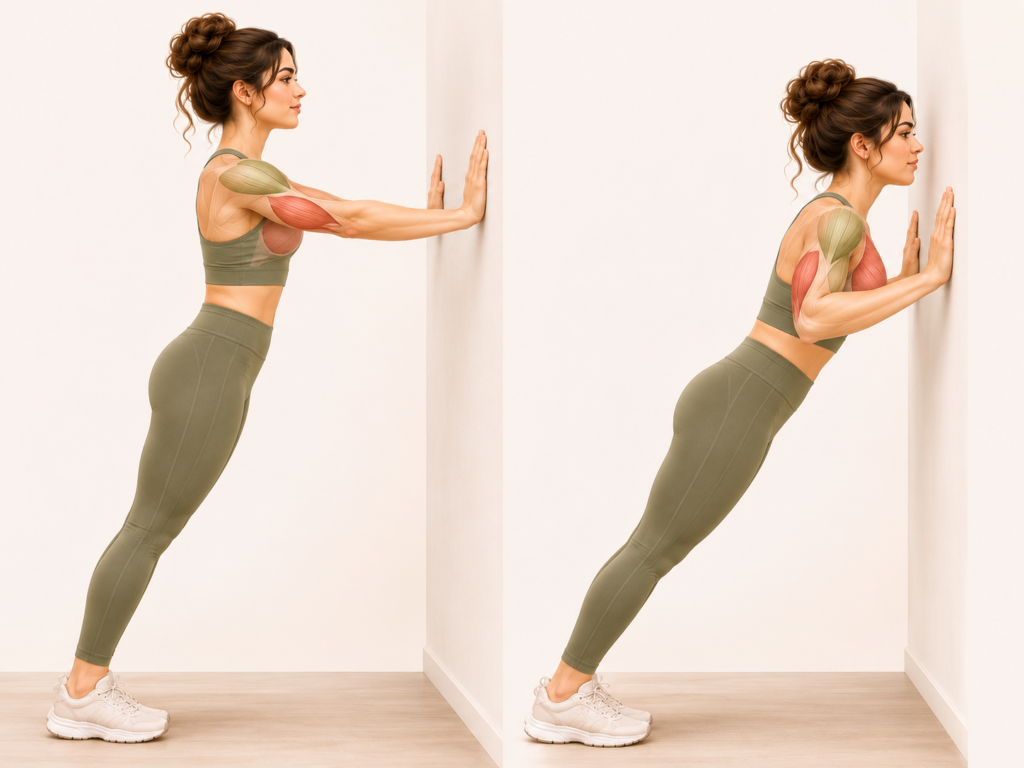
How to perform a wall push-up:
- Stand facing a wall, approximately an arm’s length away.
- Place your palms against the wall at chest height.
- Position your hands slightly wider than shoulder-width.
- Keep your body aligned from head to heels.
- Bend your elbows slowly and bring your chest towards the wall.
- Push through your palms to return to the starting position.
Beginner starting point: 1–2 sets of 8–12 repetitions.
Common mistakes:
- Allowing the hips to sag.
- Moving only the head towards the wall.
- Flaring the elbows excessively.
- Rushing through the movement.
Progression: Move your feet slightly farther from the wall to increase the challenge. Later, progress to an elevated push-up using a stable surface.
3. Glute Bridges
Primary muscles targeted: Gluteus maximus.
Secondary muscles: Hamstrings and core stabilisers.
Equipment: Exercise mat or comfortable floor surface.
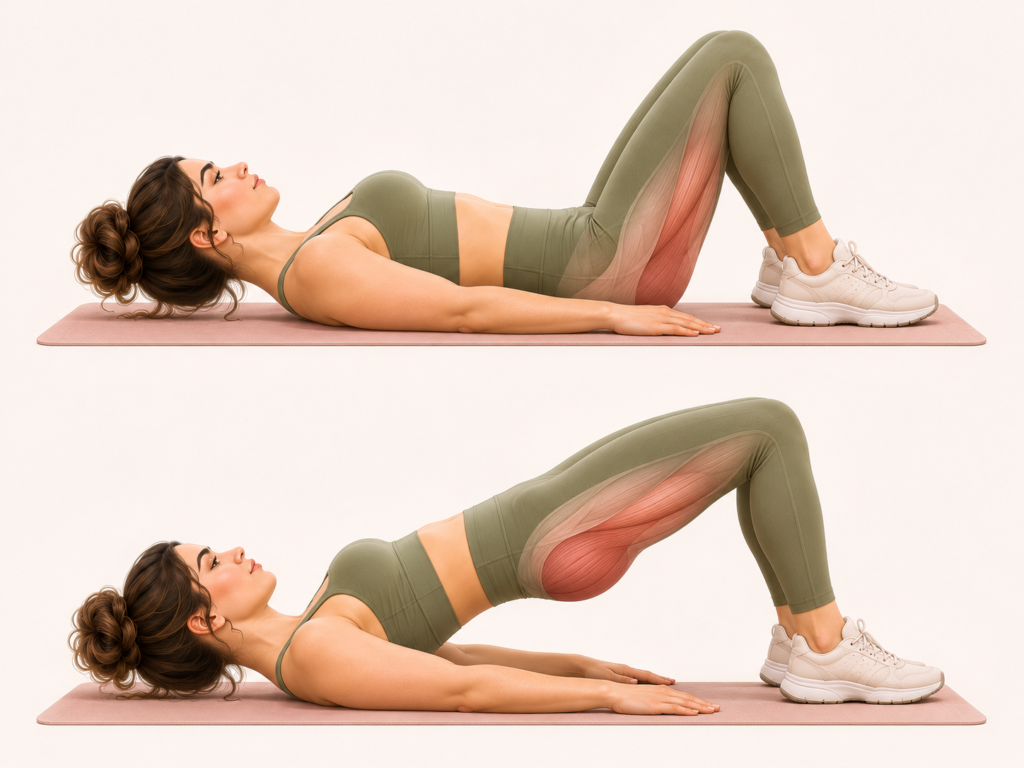
How to perform a glute bridge:
- Lie on your back with your knees bent.
- Place your feet flat on the floor, approximately hip-width apart.
- Rest your arms beside your body.
- Gently brace your abdomen.
- Press through your feet and lift your hips.
- Stop when your shoulders, hips and knees form a comfortable diagonal line.
- Lower your hips slowly.
Beginner starting point: 1–2 sets of 10–12 repetitions.
Common mistakes:
- Arching the lower back excessively.
- Pushing through the toes instead of using the whole foot.
- Lifting too high.
- Rushing the lowering phase.
Progression: Pause briefly at the top or use a resistance band above the knees.
4. Dumbbell Bent-Over Rows
Primary muscles targeted: Latissimus dorsi and other upper-back muscles.
Secondary muscles: Rhomboids, trapezius, rear deltoids, biceps and trunk stabilisers.
Equipment: One or two light dumbbells.
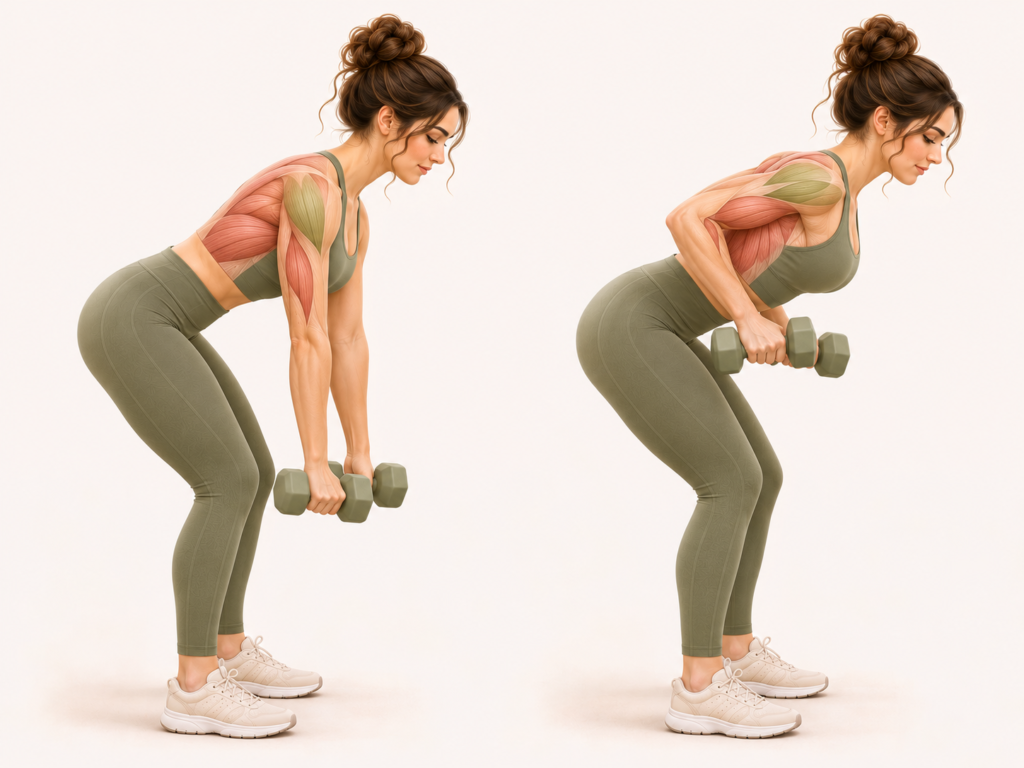
How to perform a dumbbell row:
- Hold a light dumbbell in each hand.
- Stand with your feet hip-width apart.
- Push your hips backwards and bend forward slightly.
- Keep your back in a comfortable neutral position.
- Allow your arms to hang beneath your shoulders.
- Pull the weights towards your waist.
- Lower them slowly without swinging your torso.
Beginner starting point: 1–2 sets of 8–10 repetitions.
Common mistakes:
- Rounding the back.
- Using momentum.
- Shrugging the shoulders.
- Pulling the weights too high.
- Choosing weights that prevent controlled movement.
Easier modification: Perform a supported single-arm row with one hand resting on a stable bench.
5. Dumbbell Shoulder Press
Primary muscles targeted: Deltoids.
Secondary muscles: Triceps and upper trapezius.
Equipment: Light dumbbells.
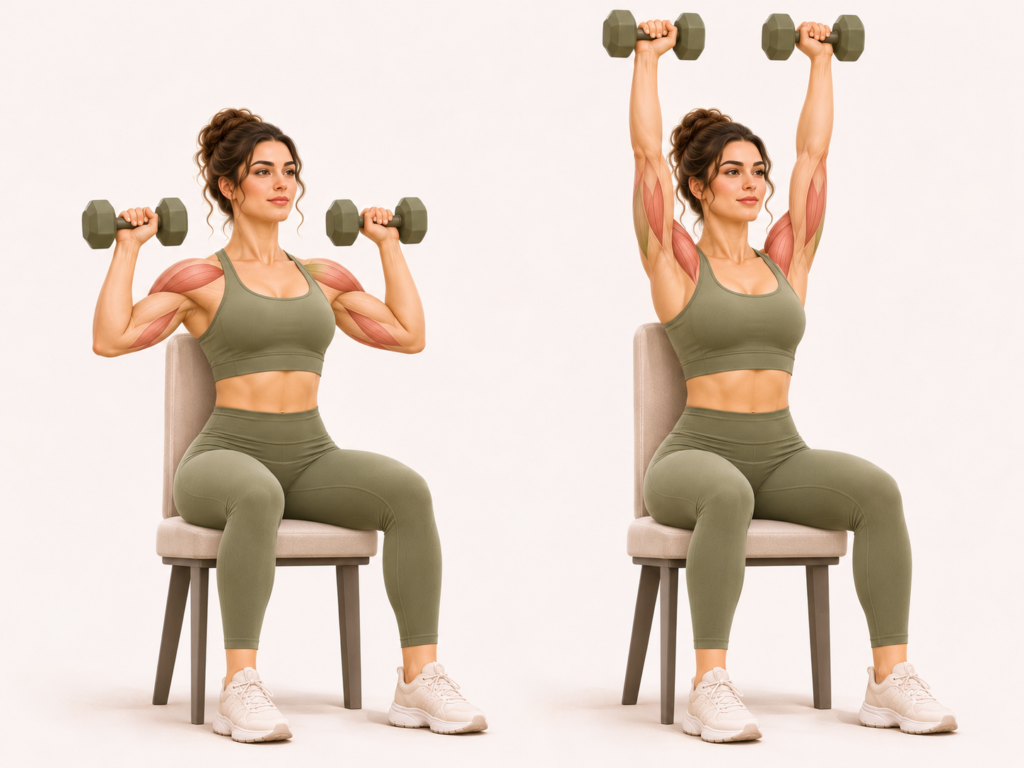
How to perform a shoulder press:
- Sit on a stable bench or stand with your feet firmly planted.
- Hold a light dumbbell in each hand.
- Bring the weights to shoulder height.
- Keep your wrists comfortable and aligned over your elbows.
- Press the dumbbells upwards without forcing your shoulders.
- Lower them slowly back to shoulder level.
Beginner starting point: 1–2 sets of 8–10 repetitions.
Common mistakes:
- Arching the lower back.
- Using excessive weight.
- Locking the elbows forcefully.
- Shrugging the shoulders throughout the movement.
Easier modification: Use a lighter resistance band or practise a shorter comfortable range of motion.
6. Dumbbell Biceps Curls
Primary muscles targeted: Biceps brachii.
Secondary muscles: Brachialis and brachioradialis.
Equipment: Light dumbbells or filled water bottles.
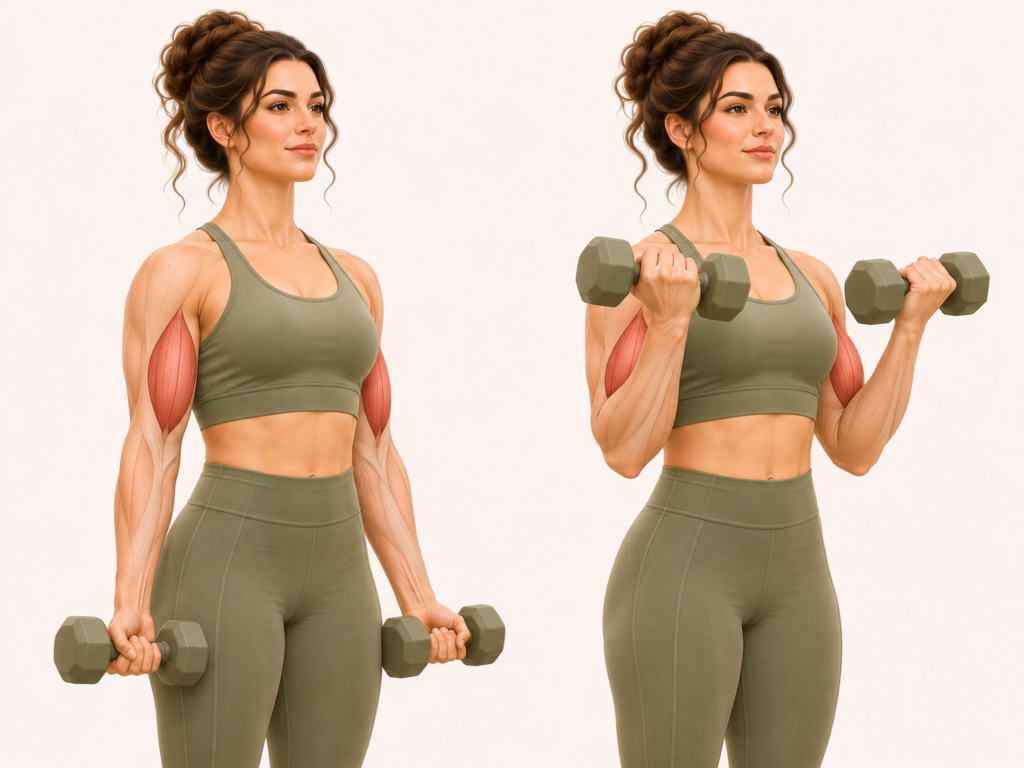
How to perform a biceps curl:
- Stand upright with a dumbbell in each hand.
- Keep your elbows close to your sides.
- Start with your arms extended comfortably.
- Bend your elbows and bring the weights towards your shoulders.
- Keep your upper arms relatively still.
- Lower the weights slowly.
Beginner starting point: 1–2 sets of 10 repetitions.
Common mistakes:
- Swinging the torso.
- Moving the elbows forward excessively.
- Using momentum.
- Lowering the weights too quickly.
7. Resistance-Band Triceps Extensions
Primary muscles targeted: Triceps brachii.
Secondary muscles: Shoulder stabilisers and core muscles.
Equipment: A resistance band with a secure anchor.
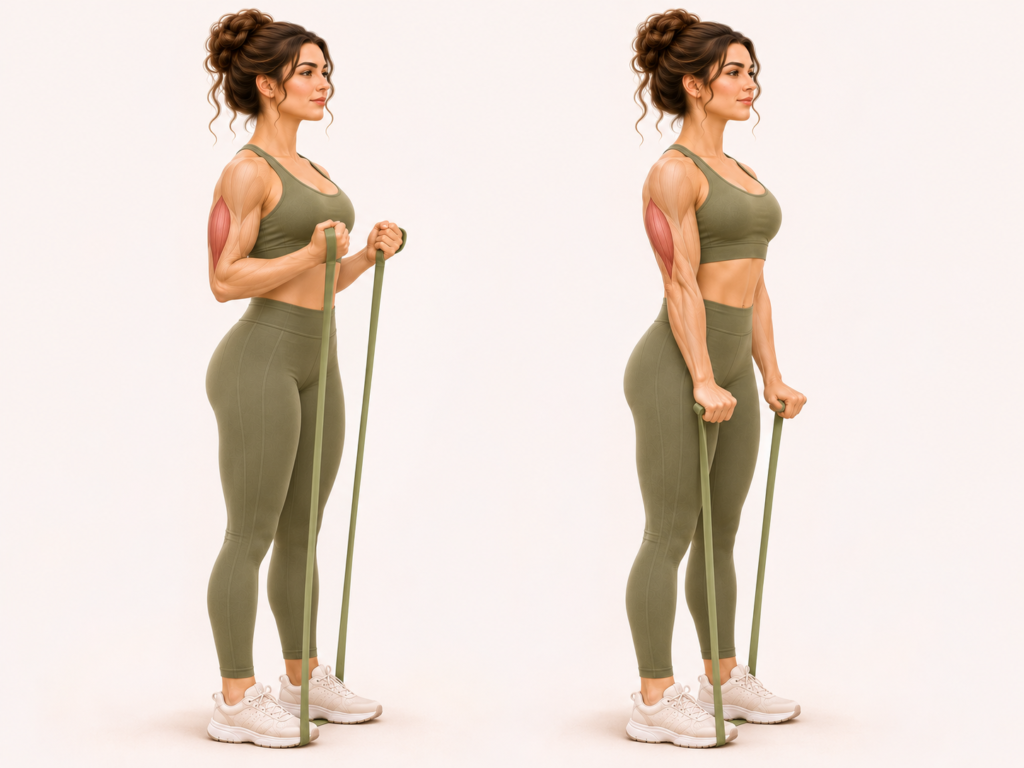
How to perform a band triceps extension:
- Secure the resistance band to a suitable stable anchor above or behind you.
- Hold the band with both hands or one hand, depending on the variation.
- Keep your elbows close to your torso.
- Begin with your elbows bent.
- Straighten your elbows against the band’s resistance.
- Return slowly to the starting position.
Beginner starting point: 1–2 sets of 8–12 repetitions.
Safety: Check the band and anchor before use. Never use a damaged band or an unsecured door attachment.
8. Bird Dog
Primary purpose: Core stability and coordination.
Muscles involved: Deep abdominal muscles, spinal stabilisers, gluteal muscles and shoulder stabilisers.
Equipment: Exercise mat.
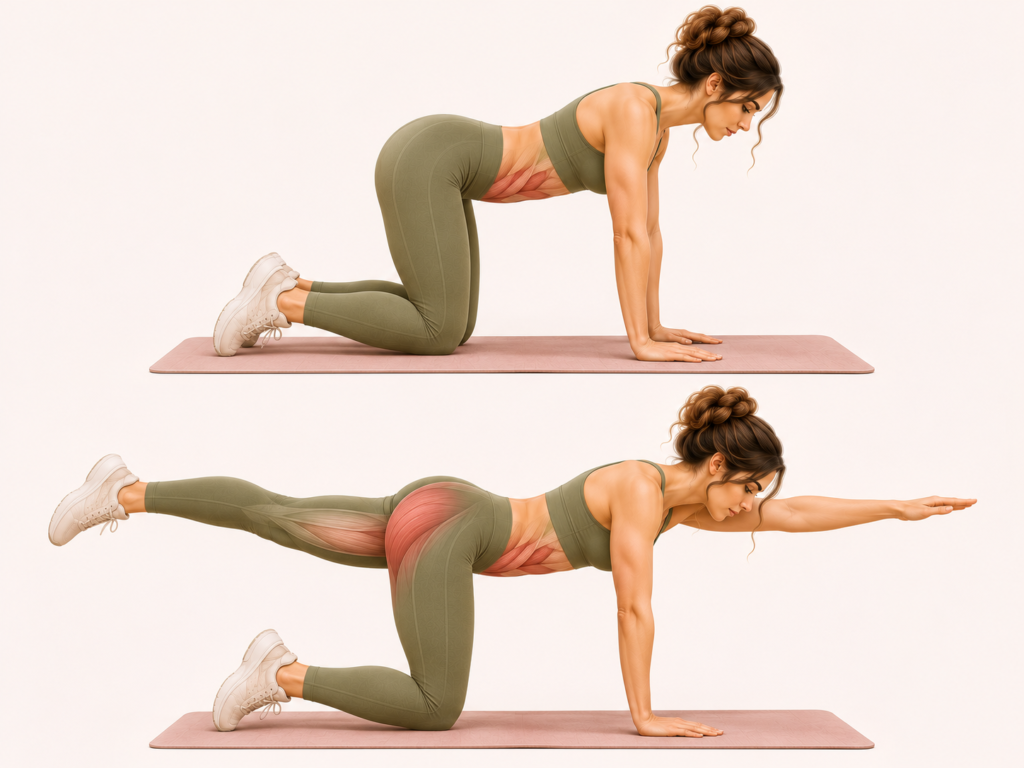
How to perform a bird dog:
- Start on your hands and knees.
- Place your hands under your shoulders and knees under your hips.
- Keep your spine in a comfortable neutral position.
- Extend your right arm forwards and left leg backwards.
- Avoid rotating or arching your back.
- Return to the starting position.
- Repeat on the opposite side.
Beginner starting point: 1–2 sets of 6–8 controlled repetitions per side.
Common mistakes:
- Rotating the hips.
- Raising the leg too high.
- Arching the lower back.
- Moving too quickly.
Easier modification: Extend one arm or one leg at a time.
Compound Exercises vs Isolation Exercises
Two common types of strength training exercises are compound exercises and isolation exercises.
Understanding the difference helps you build a balanced beginner workout.
Compound exercises
Compound exercises involve more than one joint and multiple muscle groups working together.
Examples include:
- Squats.
- Push-ups.
- Rows.
- Lunges.
- Chest presses.
- Shoulder presses.
A squat involves movement at the hips, knees and ankles. The quadriceps and gluteal muscles contribute strongly, while other muscles help stabilise the body.
Compound exercises are useful for beginners because they train movement patterns used in everyday activities.
Isolation exercises
Isolation exercises focus more specifically on movement at one joint and a smaller number of primary muscles.
Examples include:
- Biceps curls.
- Triceps extensions.
- Leg extensions.
- Hamstring curls.
- Lateral raises.
These exercises can complement compound movements by providing additional work for particular muscles.
A balanced beginner programme should generally prioritise a few manageable compound movements and add isolation exercises when useful.
How Many Sets and Repetitions Should Beginners Do?
One of the most common questions about beginner strength training is how many sets and repetitions to perform.
A repetition, often called a rep, is one complete movement of an exercise.
A set is a group of repetitions performed before resting.
For example, completing 10 squats, resting and then completing another 10 squats means you have performed two sets of 10 repetitions.
A practical beginner starting point
| Training variable | Beginner starting guide |
|---|---|
| Training frequency | 2 non-consecutive days per week |
| Exercises | Approximately 5–8 selected movements |
| Sets | Start with 1–2 sets per exercise |
| Repetitions | Often 8–12 controlled repetitions |
| Rest | Around 1–2 minutes, or longer if needed |
| Workout duration | Approximately 25–45 minutes |
| Progression | Increase gradually when technique is consistent |
These are practical starting suggestions, not strict requirements for everyone.
The NHS recommends starting gradually and building up over time. It describes 8–12 repetitions as a useful range for strength exercises, with at least two sets as a general target for adults who can manage them. The appropriate starting point depends on the individual.
Should beginners lift heavy weights?
No. Beginners do not need to start with heavy weights.
Choose a resistance that allows you to perform each repetition with controlled technique.
The final few repetitions may feel challenging, but you should still be able to maintain your posture and movement control.
If you have to swing the weights, hold your breath excessively or change your posture to complete the movement, the resistance may be too high.
How much rest should you take?
Rest allows your muscles and nervous system to recover between challenging sets.
For a beginner, approximately 1–2 minutes is a reasonable starting point for many exercises. You may need longer after demanding movements such as squats or rows.
Do not rush through a workout simply to finish it faster.
What Equipment Do You Need for Beginner Strength Training?
You can start with very little equipment.
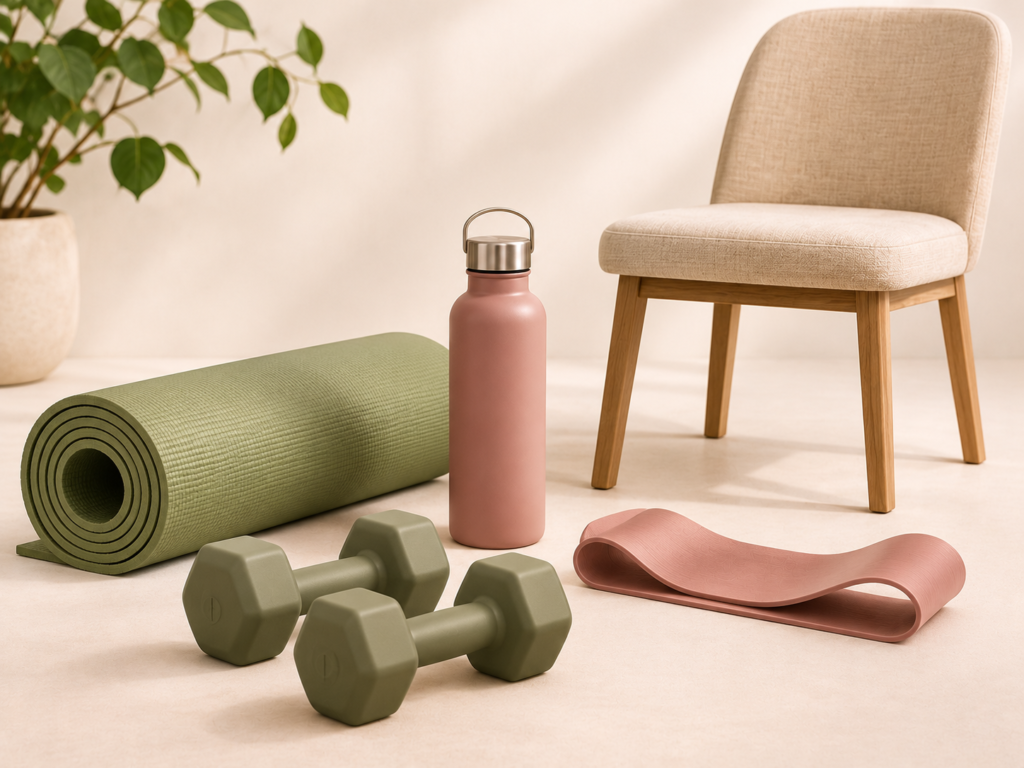
1. Bodyweight
Bodyweight exercises are an accessible starting point.
Examples include squats, wall push-ups, glute bridges, bird dogs, modified planks and chair sit-to-stands.
2. Dumbbells
Dumbbells allow you to perform a wide range of upper- and lower-body exercises.
Beginners can start with light weights that permit controlled movement.
3. Resistance bands
Resistance bands are portable and can be used for rows, presses, curls and other resistance exercises.
They are particularly useful for people who want to exercise at home without purchasing a large collection of weights.
4. Weight machines
Gym machines can help beginners practise controlled movements because they guide the path of resistance.
Examples include:
- Leg press.
- Chest press.
- Seated row.
- Lat pulldown.
- Leg curl.
Machines still require appropriate seat adjustment, positioning and technique. Ask a qualified gym instructor for help if you are unsure how to set them up.
5. Exercise mat and stable chair
A mat can make floor exercises more comfortable. A stable chair can support beginner modifications such as chair squats and sit-to-stands.
Our recommendation: Start with bodyweight exercises or light resistance. Add equipment gradually when you understand the basic movement patterns.
How to Start Strength Training: A Beginner Step-by-Step Guide
If you have never followed a strength training programme, use this simple process.
Step 1: Set a realistic starting goal
Start with two strength sessions per week.
You do not need to train every day to make progress.
Choose a schedule that fits your lifestyle and allows sufficient recovery between sessions.
Step 2: Learn the basic movement patterns
Start by practising:
- Squatting.
- Pushing.
- Pulling.
- Hip hinging.
- Core stabilisation.
These movement patterns provide a foundation for many common resistance exercises.
Step 3: Choose manageable resistance
Use your body weight, light dumbbells or resistance bands.
Your goal is to learn how to control the movement, not to lift the heaviest possible weight.
Step 4: Warm up
Spend approximately 5–10 minutes preparing for your workout.
A warm-up might include easy walking or marching, gentle arm circles, shoulder rolls, comfortable hip movements and a few easy practice squats.
A warm-up should prepare you for exercise without exhausting you.
Step 5: Follow a simple routine
Choose exercises that work different muscle groups.
For example, squats for the legs and hips, wall push-ups for the chest and arms, rows for the back, glute bridges for the hips and bird dogs for core stability.
Step 6: Record your progress
Keep a simple workout log.
Record the exercise name, weight or resistance used, sets, repetitions, how difficult the exercise felt and any technique issues.
This makes it easier to identify gradual improvements.
Beginner Strength Training Weekly Plan
A two-day full-body routine is a practical starting point for many healthy adults who are new to resistance training.
The schedule below covers the major muscle groups while leaving recovery time between strength sessions.
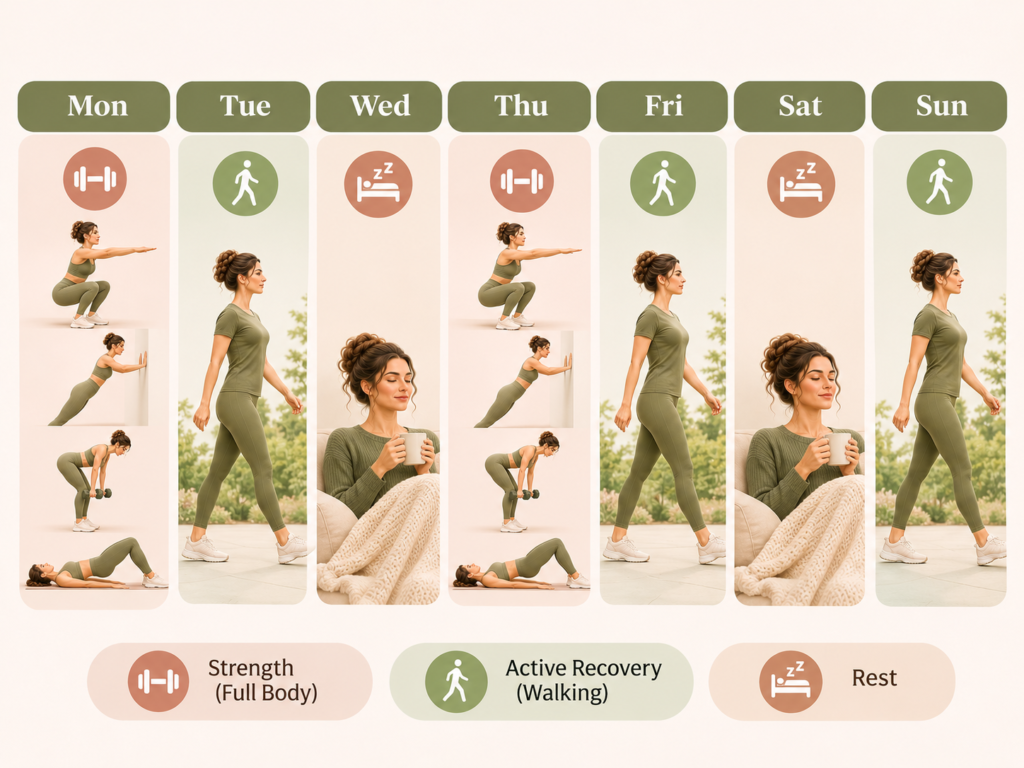
Example weekly schedule
| Day | Activity | Focus |
|---|---|---|
| Monday | Strength Workout A | Full body |
| Tuesday | Walking or gentle activity | Recovery and aerobic movement |
| Wednesday | Rest or light mobility | Recovery |
| Thursday | Strength Workout B | Full body |
| Friday | Walking or gentle activity | Aerobic movement |
| Saturday | Optional enjoyable activity | Walking, cycling or mobility |
| Sunday | Rest | Recovery |
The days can be changed to fit your schedule. The important part is leaving time to recover between challenging full-body sessions.
Workout A — Full-body beginner strength
| Exercise | Sets | Repetitions |
|---|---|---|
| Bodyweight squats | 2 | 8–10 |
| Wall push-ups | 2 | 8–12 |
| Dumbbell rows | 2 | 8–10 |
| Glute bridges | 2 | 10–12 |
| Bird dogs | 1–2 | 6–8 per side |
Workout B — Full-body beginner strength
| Exercise | Sets | Repetitions |
|---|---|---|
| Chair squats or supported squats | 2 | 8–10 |
| Elevated push-ups | 2 | 8–10 |
| Dumbbell shoulder press | 1–2 | 8–10 |
| Biceps curls | 1–2 | 10–12 |
| Resistance-band triceps extensions | 1–2 | 8–12 |
| Glute bridges | 2 | 10–12 |
These are example sessions, not a requirement to perform every exercise exactly as written.
Choose comfortable variations, use light resistance and reduce the number of sets if needed.
If you are completely new to exercise, you can begin with one set per movement and gradually build towards the suggested structure.
How to adjust the weekly plan
If you train at home: Use bodyweight exercises, water bottles as light weights or resistance bands.
If you train at a gym: You can substitute suitable machines for exercises such as squats, rows and chest presses.
If you have limited time: Choose four or five exercises that cover different movement patterns rather than rushing through the entire routine.
If you need more recovery: Keep only two strength sessions and reduce other demanding activity until you adapt.
How to Progress: Your First Four Weeks of Strength Training
You do not need to increase the weight every workout.
Progressive overload means gradually increasing the challenge placed on your muscles over time.
This can involve increasing repetitions, adding a small amount of resistance, improving control or progressing to a more challenging variation.
A simple four-week progression example
| Week | Training focus | What to do |
|---|---|---|
| Week 1 | Learn technique | Practise movements with bodyweight or very light resistance |
| Week 2 | Build consistency | Repeat the same routine and improve control |
| Week 3 | Increase gradually | Add a few repetitions if technique remains comfortable |
| Week 4 | Review progress | Consider a small resistance increase if you can complete all repetitions comfortably |
This is an example progression, not a fixed deadline. Some people may need longer at each stage.
When should you increase the weight?
Consider increasing resistance when:
- You can complete your planned repetitions with controlled technique.
- Your posture remains stable.
- You are not relying on momentum.
- The current resistance no longer provides an appropriate challenge.
Make small changes rather than jumping to a much heavier weight.
The objective is sustainable progress, not constant exhaustion.
How Often Should Beginners Do Strength Training?
For most healthy adults, two strength-training days per week is a reasonable starting target.
The sessions should involve the major muscle groups, including the legs, hips, back, abdomen, chest, shoulders and arms.
The WHO, CDC and UK guidance all support muscle-strengthening activity on at least two days per week.
You can increase training frequency later if your recovery, experience and goals support it.
However, more training is not automatically better. Consistency, suitable resistance, technique and recovery matter.
How Long Does It Take to See Results From Strength Training?
There is no universal timeline.
Some beginners notice improvements in coordination and exercise confidence within the first few weeks.
Strength can improve before visible muscle changes occur because your nervous system becomes more efficient at coordinating muscle activity.
Visible changes depend on several factors:
- Training consistency.
- Exercise selection.
- Resistance and progression.
- Nutrition.
- Sleep.
- Genetics.
- Starting fitness level.
- Overall health.
Instead of judging progress only by appearance, look for practical improvements.
For example, performing more controlled repetitions, using slightly greater resistance, finding stairs easier, improving balance and stability, and feeling more confident with exercise techniques are all meaningful signs of progress.
Strength Training for Women and Men: Is There a Difference?
The basic principles of strength training are similar for women and men.
Both benefit from exercises that develop strength across the major muscle groups.
Women do not need an entirely different programme, and men do not need to begin with heavy weights.
Training should be adapted to the individual’s experience, ability, goals and health.
Strength training for women
Women can use resistance training to improve muscular strength, develop muscle and support physical function.
A balanced programme may include squats, rows, push-ups, glute bridges, shoulder presses and core-stability exercises.
Strength training for men
Men can follow the same foundational movement patterns.
A beginner programme may include squats or leg presses, chest presses, dumbbell rows, hip hinges, shoulder presses and core exercises.
There is no need to test maximum lifting strength when starting out.
Can women become too muscular from strength training?
Muscle development takes consistent training, appropriate nutrition and time.
Beginning a resistance-training programme does not suddenly produce large muscles.
Women and men can adjust training volume and resistance according to their goals, but both should prioritise proper technique and gradual progression.
Common Strength Training Mistakes Beginners Should Avoid
Learning what not to do is just as important as learning the exercises.
1. Lifting too much weight too soon
Heavy resistance can make it difficult to control a movement.
Start with a load you can manage comfortably and increase it gradually.
2. Skipping the warm-up
A short warm-up prepares your body for movement.
Start with easy activity and practise the movements you plan to perform.
3. Ignoring exercise technique
Poor positioning can make an exercise less effective and may increase injury risk.
Use controlled movements and seek help from a qualified fitness professional when necessary.
4. Training the same muscles hard every day
Muscles need time to recover after challenging resistance sessions.
Avoid repeatedly performing demanding workouts for the same muscle groups without sufficient recovery.
5. Comparing your progress with others
People begin at different fitness levels and progress at different rates.
Focus on your own technique, consistency and gradual improvements.
6. Expecting immediate visible results
Strength development is a process.
Set realistic goals and evaluate progress over time rather than expecting dramatic changes after a few workouts.
7. Neglecting recovery and sleep
Recovery is part of training.
Adequate sleep, appropriate nutrition and rest days support your ability to continue exercising consistently.
Recovery, Nutrition and Hydration for Strength Training
A good beginner strength training programme includes more than exercise selection.
Your body also needs appropriate nutrition, fluids and recovery.
Eat a balanced diet
Include a variety of foods that provide:
- Protein for muscle repair and maintenance.
- Carbohydrates for energy.
- Healthy fats for overall health.
- Vitamins and minerals.
- Fibre from vegetables, whole grains, legumes and other suitable foods.
Useful protein sources include eggs, fish, chicken, dairy products, beans, lentils, tofu and other legumes.
You do not need expensive supplements to begin strength training.
Stay hydrated
Drink fluids regularly throughout the day, and have access to water during exercise.
Fluid needs vary depending on activity, environment, sweat loss and individual circumstances.
Prioritise sleep
Sleep supports recovery and overall health.
Maintain a regular sleep routine where possible and avoid treating rest days as lost training days.
Understand muscle soreness
Mild muscle soreness can occur after unfamiliar exercise, especially when you introduce new movements.
However, sharp pain, significant swelling, severe weakness or pain that changes how you move should not be dismissed as normal soreness.
Stop the exercise and seek appropriate medical advice if symptoms are concerning.
Safety Tips Before Starting Strength Training
Most healthy adults can begin with manageable resistance and gradual progression. However, individual circumstances matter.
Before starting, consider the following:
- If you have been inactive for a long time, have a medical condition or are concerned about exercise safety, speak with your healthcare professional.
- If you have an injury, choose exercises that do not aggravate it and obtain suitable guidance.
- Learn equipment settings before using gym machines.
- Check resistance bands for damage.
- Use stable surfaces and secure equipment.
- Avoid holding your breath throughout a repetition.
- Stop if you experience chest discomfort, dizziness, unusual breathlessness or concerning pain.
If you are pregnant, recently postpartum, recovering from surgery or managing a condition that affects movement or exercise tolerance, seek guidance appropriate to your circumstances.
Beginner Strength Training Checklist
Before your first session, use this simple checklist:
- Choose two days for strength training.
- Select five or six beginner-friendly exercises.
- Prepare a stable exercise space.
- Choose comfortable clothing and footwear.
- Have water available.
- Begin with a short warm-up.
- Use manageable resistance.
- Focus on correct posture and controlled movements.
- Record your sets and repetitions.
- Allow time for recovery.
You do not need to complete a perfect workout. The most useful first step is to begin with a manageable routine and build consistency.
Frequently Asked Questions About Strength Training for Beginners
Start with two manageable full-body workouts per week. Learn basic movements such as squats, wall push-ups, rows and glute bridges. Use bodyweight or light resistance until you can perform the exercises with controlled technique.
Two non-consecutive strength-training days per week are a reasonable starting point for many adults. Train the major muscle groups and allow time for recovery between sessions.
A practical starting point is 1–2 sets of approximately 8–12 repetitions for many exercises. Your appropriate training volume depends on your fitness level, exercise selection and recovery.
Yes. Bodyweight squats, wall push-ups, glute bridges and bird dogs can help beginners develop strength without traditional gym equipment. Resistance bands and household items such as filled water bottles can provide additional resistance when used safely.
They provide different benefits. Strength training develops muscular strength, while aerobic exercise supports cardiovascular fitness. Both are valuable components of an overall physical activity routine.
Strength training can support weight management by increasing physical activity and helping maintain or develop lean muscle. Sustainable weight management also involves nutrition, aerobic activity, sleep and other lifestyle factors.
Conclusion
Strength training for beginners does not have to be complicated. You can start with simple bodyweight movements, light dumbbells or resistance bands and gradually build a routine that works for your fitness level.
Exercises such as squats, push-ups, rows, glute bridges and shoulder presses help develop strength across different muscle groups. Learning correct technique, choosing manageable resistance and allowing sufficient recovery are more important than lifting heavy weights at the beginning.
For many adults, two full-body strength-training sessions each week provide a practical starting point. As your confidence and fitness improve, you can gradually increase the challenge and explore different exercises.
Remember that progress is not only about how much weight you lift or how your body looks. Better movement control, improved everyday strength and greater confidence are meaningful achievements too.
Start small, stay consistent and give your body time to adapt.
At LifeMate, we believe fitness should be practical, sustainable and accessible. Your strength journey starts with one manageable step.
Medical Disclaimer
This article is intended for general educational and informational purposes only. It is not a substitute for personalised medical advice, diagnosis, treatment or an individual exercise prescription.
Exercise suitability varies depending on age, health, fitness level, injuries and other individual circumstances.
If you have a medical condition, a history of injury, are pregnant or recently postpartum, or have concerns about starting strength training, consult an appropriately qualified healthcare professional before beginning a new programme.
Stop exercising if you experience chest discomfort, dizziness, unusual shortness of breath, severe pain or other concerning symptoms. Seek appropriate medical attention when necessary.
Always use safe equipment, appropriate resistance and controlled exercise techniques.
Sources and References
UK Chief Medical Officers — Physical Activity Guidelines. Adult recommendations for aerobic and muscle-strengthening activity.
https://www.gov.uk/government/publications/physical-activity-guidelines-uk-chief-medical-officers-report/uk-chief-medical-officers-physical-activity-guidelines
NHS — How to Improve Your Strength and Flexibility. Strength exercise guidance, sets, repetitions and major muscle groups.
https://www.nhs.uk/live-well/exercise/how-to-improve-strength-flexibility/
NHS — Physical Activity Guidelines for Adults Aged 19 to 64. Weekly activity and muscle-strengthening recommendations.
https://www.nhs.uk/live-well/exercise/physical-activity-guidelines-for-adults-aged-19-to-64/
American College of Sports Medicine — Resistance Training for Health. Evidence-informed resistance exercise guidance.
https://www.acsm.org/docs/default-source/files-for-resource-library/resistance-training-for-health.pdf
American Heart Association — Strength and Resistance Training Exercise. General strength training guidance and safety considerations.
https://www.heart.org/en/healthy-living/exercise-and-physical-activity/fitness-basics/strength-and-resistance-training-exercise
American Heart Association — Resistance Exercise Training in Individuals With and Without Cardiovascular Disease: 2023 Update. Scientific statement on resistance exercise.
https://pmc.ncbi.nlm.nih.gov/articles/PMC11209834/
CDC — Adult Activity: An Overview. Adult physical activity and muscle-strengthening recommendations.
https://www.cdc.gov/physical-activity-basics/guidelines/adults.html