Starting a fitness routine does not have to mean joining a gym, purchasing expensive equipment or following complicated workout programmes. Some of the most useful beginner exercises can be performed at home using your own body weight, a stable chair and a little open space.
Home workouts for beginners offer a practical way to develop strength, improve cardiovascular fitness, increase mobility and build a consistent exercise habit. Whether you have never followed a workout routine before or are returning to exercise after a long break, you can start with simple movements and gradually increase the challenge as your fitness improves.
The key is to choose exercises that match your current ability, learn the correct technique and give your body enough time to recover.
In this guide, you will discover 10 easy home exercises for beginners, how to perform each movement correctly, a simple 20-minute full-body home workout, and a practical four-week beginner workout plan. You will also learn how often to exercise, how to make workouts easier or more challenging, and how home exercise can support long-term health and weight management.
You do not need to be fit before you begin. You simply need a safe place to move and a routine you can build on.
What Is a Home Workout?
A home workout is a planned exercise session performed inside or around your home rather than in a gym or fitness facility. It can include bodyweight exercises, aerobic movements, strength training, balance exercises, stretching and mobility work.
Many beginner home workouts use bodyweight resistance. This means your body provides the resistance during movements such as squats, wall push-ups, glute bridges and modified planks.
A home workout can be adapted to different fitness levels. Someone who is completely new to exercise might begin with chair squats, gentle marching and wall push-ups. As strength and coordination improve, they may progress to regular squats, floor push-ups or more challenging variations.
A balanced home exercise routine can include four important types of movement:
1. Cardiovascular exercise
Cardiovascular exercise increases your heart rate and breathing. Examples include marching in place, dancing, walking, stair climbing and low-impact aerobic movements.
These activities help improve cardiovascular endurance and contribute to your weekly aerobic activity.
2. Strength training
Strength exercises challenge your muscles against resistance. You can use your body weight to perform squats, push-ups, lunges, bridges and other movements.
Bodyweight exercises can help beginners develop strength without purchasing gym equipment.
3. Mobility and flexibility exercises
Mobility exercises help you move your joints through comfortable ranges of motion. Stretching can help maintain flexibility and make everyday movements feel more comfortable.
Examples include gentle shoulder circles, hip movements, ankle circles and controlled stretches.
4. Balance and stability exercises
Balance exercises challenge your ability to maintain control while standing, moving or changing positions.
Bird dogs, supported single-leg movements and controlled standing exercises can help beginners practise coordination and stability.
A well-rounded indoor fitness routine can include aerobic exercise, strength training, stretching and balance work.
Benefits of Working Out at Home
A beginner home workout routine can offer several physical and practical benefits. You can exercise at a convenient time, adjust movements to your current fitness level and gradually develop a routine without relying on gym access.
Here are some reasons to consider adding home workouts to your lifestyle.
1. Convenient and flexible exercise
One of the biggest advantages of exercising at home is convenience. You do not need to travel to a gym, wait for equipment or organise your day around a fitness class.
You can complete a short workout before work, during a break or in the evening. Even a brief session can be a useful starting point when you are building a new exercise habit.
2. Improved muscular strength and endurance
Bodyweight exercises such as squats, wall push-ups and glute bridges challenge different muscle groups.
Practising these movements regularly can help improve muscular strength and endurance. As you become more comfortable, you can gradually increase repetitions, add another set or choose a more challenging variation.
3. Better cardiovascular fitness
Low-impact aerobic exercises, including marching in place and dancing, can increase your heart rate and help develop cardiovascular endurance.
You can adjust the pace and duration to match your current fitness level.
4. Improved balance and coordination
Exercises that require controlled movement and body positioning can help develop balance and coordination.
This is particularly useful when learning movements such as bird dogs, supported lunges and standing knee raises.
5. More daily movement
A structured home workout can help reduce sedentary time and encourage you to move more throughout the day.
You can combine planned exercise sessions with walking, household activities and short movement breaks.
6. Support for physical and mental well-being
Regular physical activity supports overall health and may contribute to better mood, sleep and stress management.
You do not need to complete an intense workout to begin benefiting from increased movement. Starting with an amount you can comfortably manage is a sensible approach.
The UK Chief Medical Officers recommend that adults aim for at least 150 minutes of moderate-intensity activity each week, alongside muscle-strengthening activities on at least two days. They also emphasise that some activity is better than none. UK Chief Medical Officers’ Physical Activity Guidelines.
What Do You Need to Start Working Out at Home?
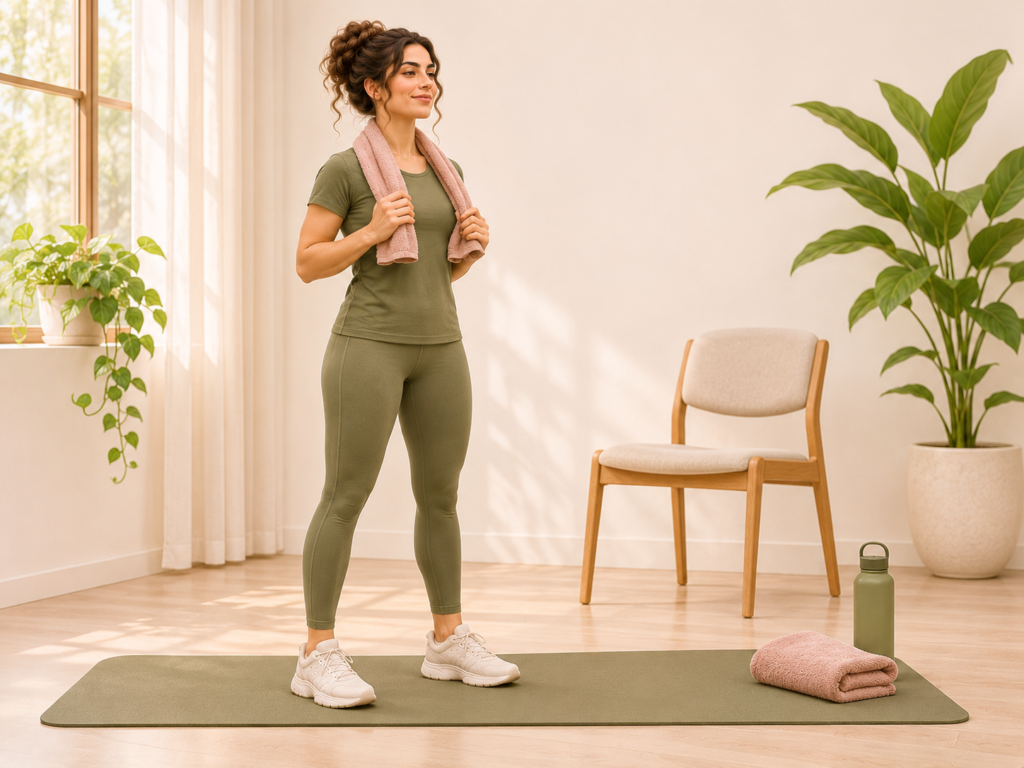
You do not need a home gym to begin exercising. Most beginner bodyweight workouts require very little equipment.
Before starting, prepare a safe and comfortable exercise space.
1. A clear exercise area
Choose a flat, stable surface with enough room to move your arms and legs without hitting furniture or other objects.
Remove loose rugs, cables and anything that could cause you to slip or trip.
2. Comfortable clothing
Wear comfortable clothing that allows you to move freely. Choose footwear appropriate for the exercises and the surface. Some controlled floor exercises may be performed barefoot if the surface is safe and suitable.
3. An exercise mat
A mat is optional but can make floor exercises such as glute bridges, bird dogs and dead bugs more comfortable.
A clean, non-slip surface is important.
4. A stable chair
A sturdy chair can help beginners practise supported squats, calf raises and modified exercises.
Make sure the chair cannot slide or tip over. Avoid using wheeled chairs.
5. Water and a towel
Keep drinking water nearby and take breaks when needed.
6. A realistic workout schedule
Choose a time that fits your daily routine. A short, manageable workout performed consistently is more useful than an ambitious programme that you cannot maintain.
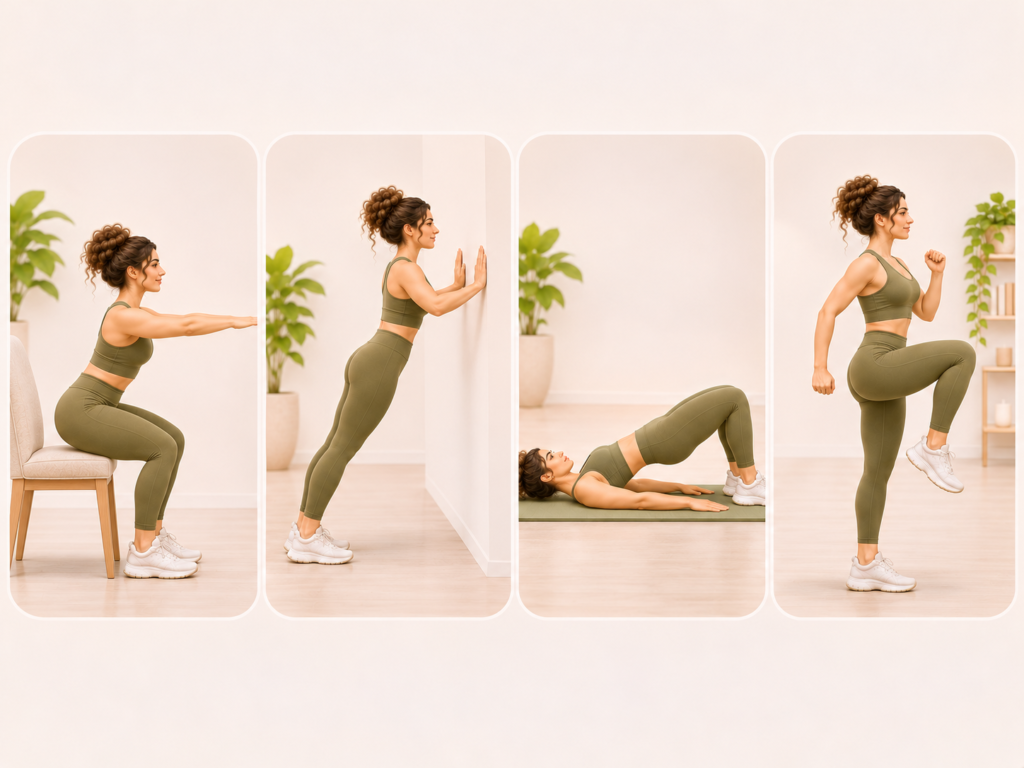
10 Easy Home Exercises for Beginners Without Equipment
The following exercises are suitable starting points for many adults who are new to home fitness. They cover different areas of the body and include both standing and floor-based movements.
You do not need to perform all 10 exercises in your first session. Begin with a smaller selection, learn the technique and increase the number of exercises gradually.
For each movement, focus on controlled repetitions rather than speed.
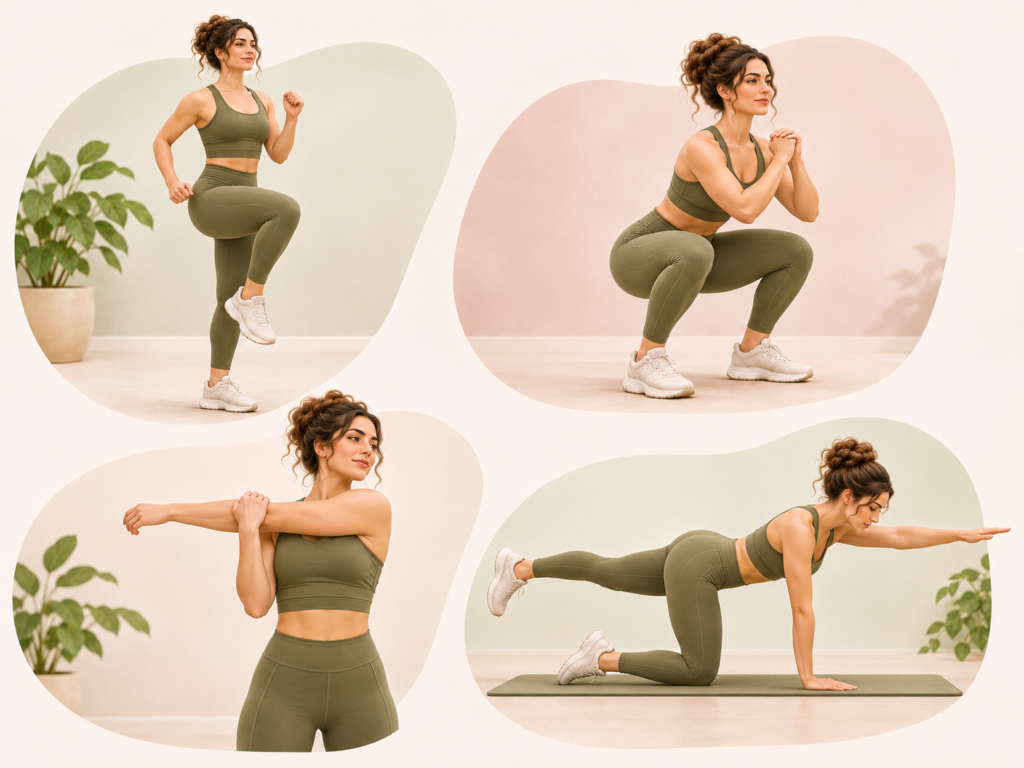
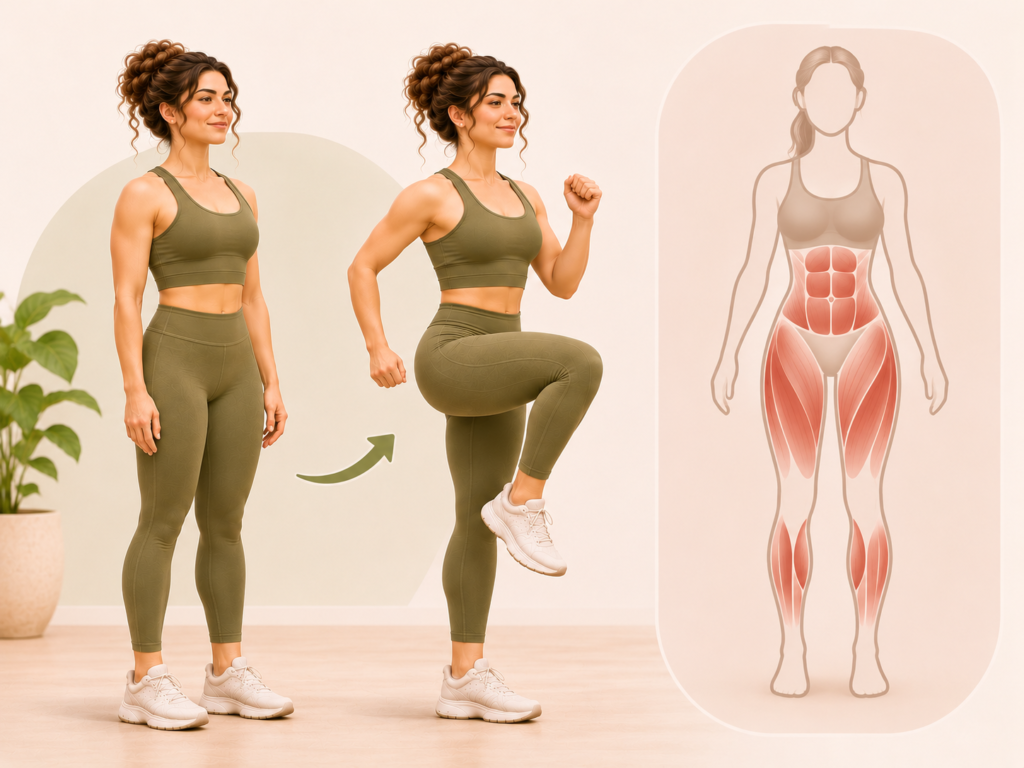
1. Marching in Place
Main purpose: Cardiovascular warm-up and low-impact aerobic movement.
Muscles involved: Hip flexors, quadriceps, calves and supporting core muscles.
Marching in place is one of the easiest ways to introduce movement into a beginner home workout. It requires no equipment and can be performed in a small space.
How to perform marching in place:
- Stand upright with your feet approximately hip-width apart.
- Keep your shoulders relaxed and look straight ahead.
- Lift one knee comfortably while moving the opposite arm forward.
- Lower your foot gently and repeat with the other leg.
- Continue alternating sides at a comfortable pace.
- Gradually increase your marching speed if you feel comfortable.
Beginner recommendation: Start with 30–60 seconds.
Common mistakes to avoid:
- Leaning excessively backwards.
- Lifting the knees higher than your comfortable range.
- Stomping your feet heavily.
- Holding your breath.
Modification: If standing balance is difficult, perform gentle seated marching in a stable chair.
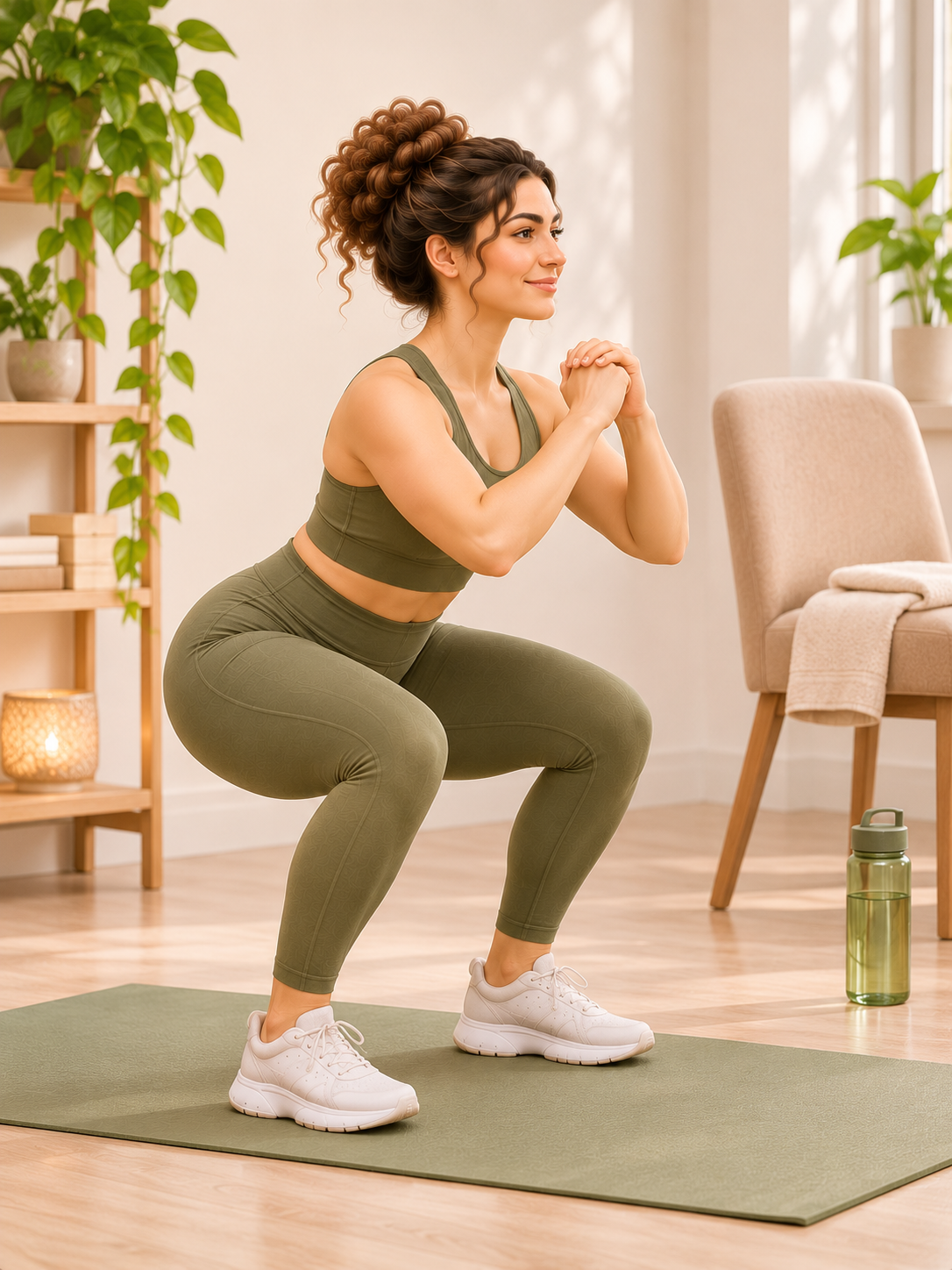
2. Chair Squats
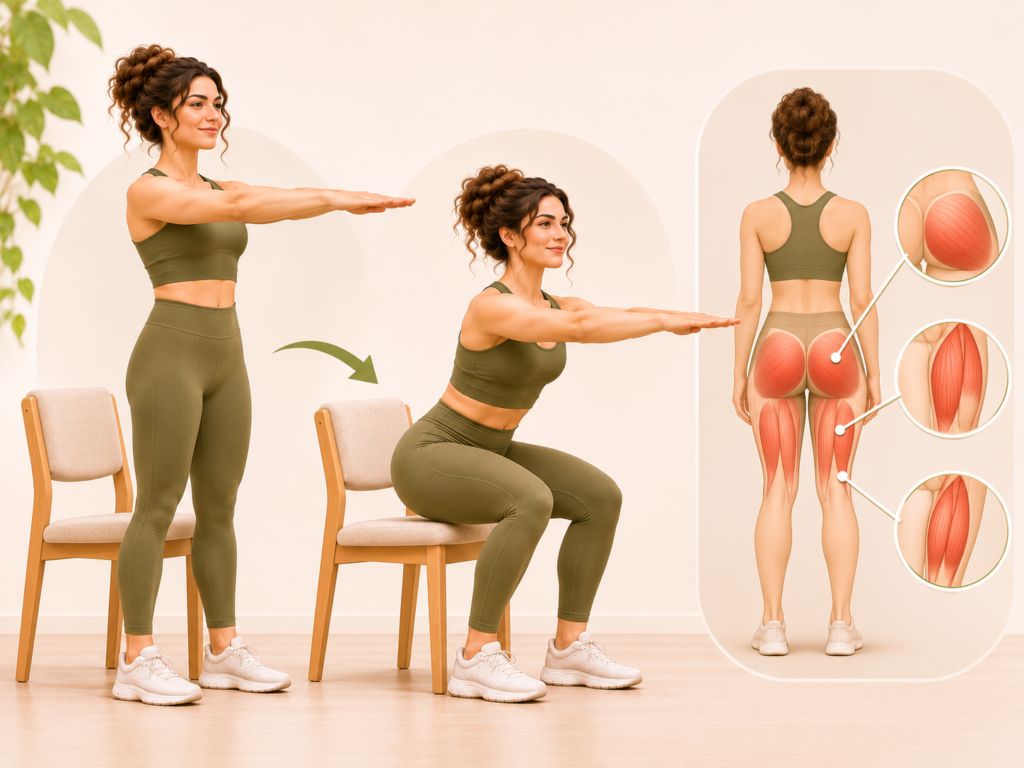
Main purpose: Developing lower-body strength.
Primary muscles: Quadriceps and gluteus maximus.
Secondary muscles: Hamstrings and core stabilisers.
Chair squats are a useful starting point for people learning how to perform a squat. The chair provides a physical reference for depth and can help beginners develop confidence and control.
How to perform chair squats:
- Stand in front of a sturdy chair with your feet approximately shoulder-width apart.
- Keep your chest lifted and your spine in a comfortable neutral position.
- Move your hips backwards as if preparing to sit down.
- Bend your knees and lower yourself slowly towards the chair.
- Lightly touch the chair or sit down under control.
- Press through your feet to return to standing.
- Repeat without rushing.
Beginner recommendation: Start with 6–10 repetitions.
Common mistakes to avoid:
- Allowing the knees to collapse inward.
- Dropping onto the chair.
- Rounding the back excessively.
- Lifting the heels off the floor.
- Squatting deeper than your mobility allows.
Modification: Use a higher, stable chair or perform a smaller squat range.
3. Wall Push-Ups
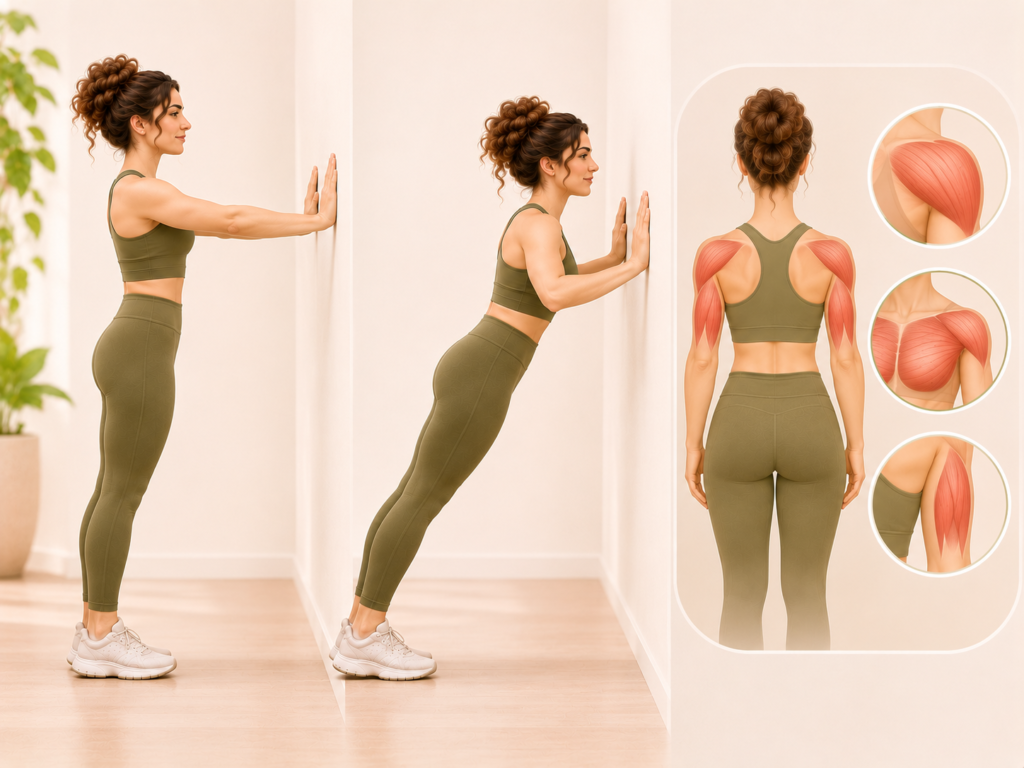
Main purpose: Developing upper-body strength.
Primary muscles: Pectoralis major (chest).
Secondary muscles: Triceps, anterior deltoids and core stabilisers.
Wall push-ups are an easier alternative to traditional floor push-ups. Because you are pushing against a wall rather than supporting your entire body weight on the floor, the movement can be adjusted to suit beginners.
How to perform wall push-ups:
- Stand facing a stable wall.
- Place both palms against the wall at approximately chest height.
- Position your hands slightly wider than shoulder-width.
- Step backwards until your body is at a comfortable angle.
- Keep your body aligned from head to hips and heels.
- Bend your elbows and slowly bring your chest towards the wall.
- Push through your palms to return to the starting position.
Beginner recommendation: Start with 6–10 repetitions.
Common mistakes to avoid:
- Allowing your hips to sag.
- Pushing your head forward.
- Flaring your elbows excessively.
- Moving too quickly.
- Placing your hands too high or too low.
Modification: Stand closer to the wall to make the exercise easier.
4. Glute Bridges
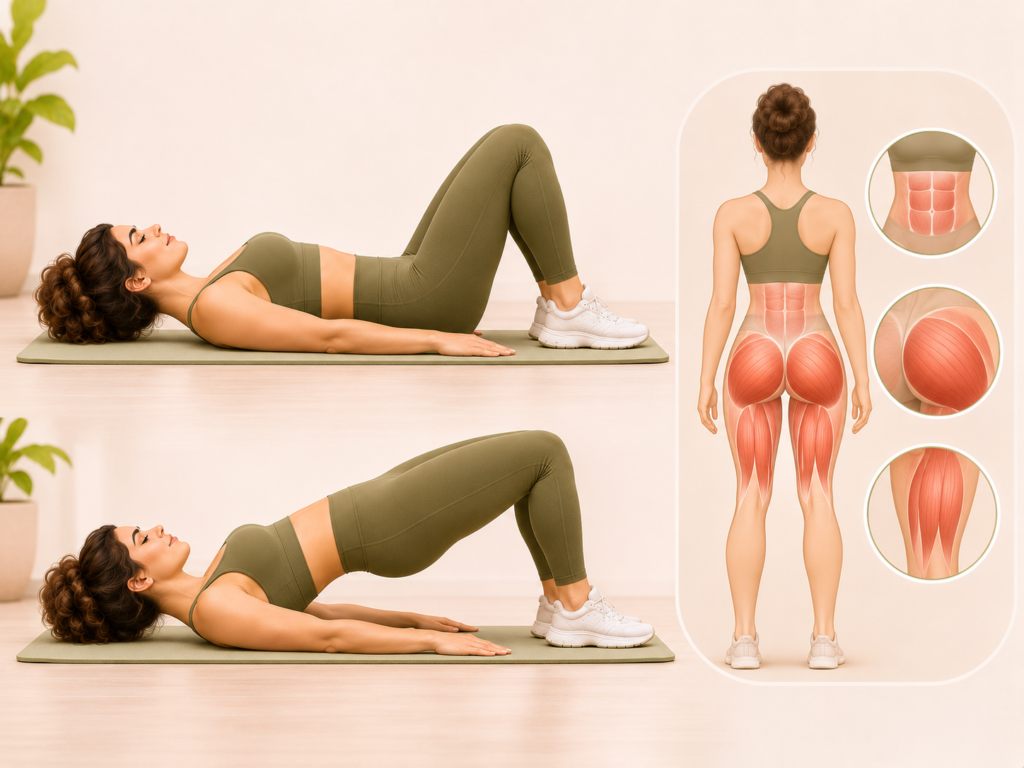
Main purpose: Strengthening the hips and posterior chain.
Primary muscles: Gluteus maximus.
Secondary muscles: Hamstrings and core stabilisers.
Glute bridges are performed on the floor and help beginners practise hip extension while maintaining control of the trunk and pelvis.
How to perform a glute bridge:
- Lie on your back on a comfortable exercise mat.
- Bend your knees and place your feet flat on the floor.
- Position your feet approximately hip-width apart.
- Rest your arms beside your body.
- Gently tighten your abdominal muscles.
- Press through your feet and lift your hips.
- Stop when your shoulders, hips and knees form a comfortable diagonal line.
- Lower your hips slowly to the starting position.
Beginner recommendation: Start with 8–12 repetitions.
Common mistakes to avoid:
- Arching the lower back excessively.
- Pushing through the toes instead of using the whole foot.
- Allowing the knees to fall inward.
- Lifting the hips higher than comfortable.
- Holding your breath.
Modification: Lift your hips only a short distance until you develop better control.
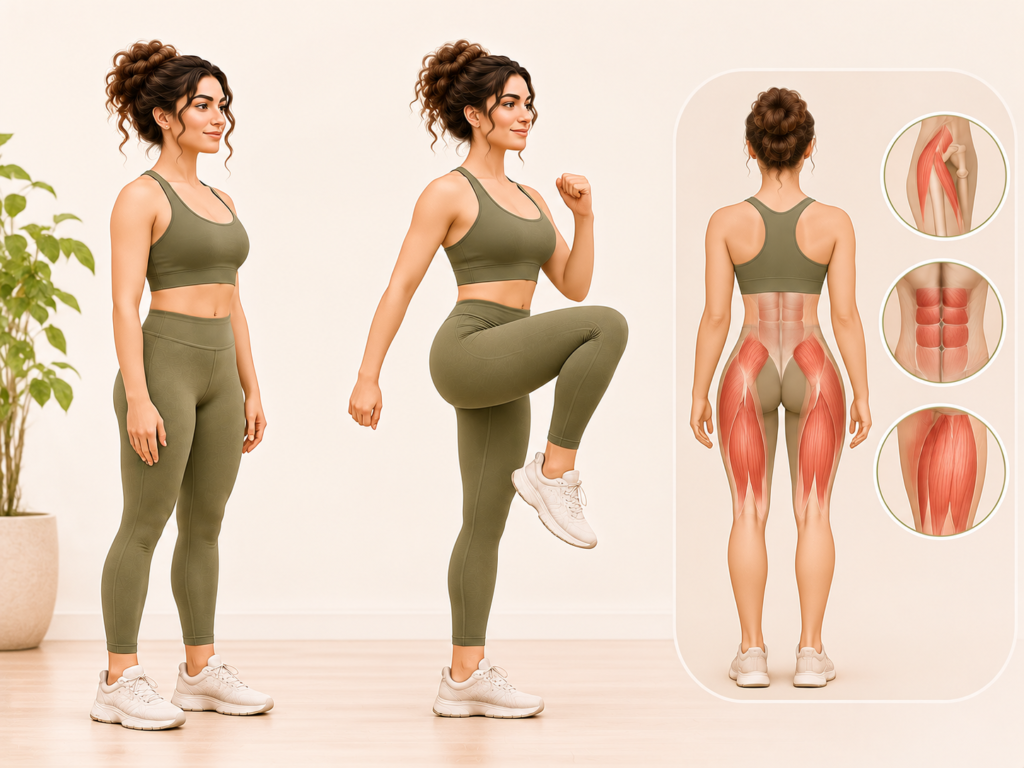
5. Standing Knee Raises
Main purpose: Low-impact aerobic movement and hip flexor activation.
Muscles involved: Hip flexors, quadriceps and core stabilisers.
Standing knee raises are a simple way to practise controlled leg movement while remaining upright. They can be performed slowly for beginners or at a slightly quicker pace for a more aerobic challenge.
How to perform standing knee raises:
- Stand upright with your feet hip-width apart.
- Keep your shoulders relaxed and your abdominal muscles gently engaged.
- Lift one knee towards hip height, or as high as feels comfortable.
- Lower the foot slowly.
- Repeat on the opposite side.
- Continue alternating while maintaining balance.
Beginner recommendation: Start with 8–10 repetitions per side.
Common mistakes to avoid:
- Leaning backwards to lift the knee.
- Swinging the leg uncontrollably.
- Rushing through repetitions.
- Allowing the standing knee to lock forcefully.
Modification: Hold a stable chair or wall for support, or reduce the knee-lift height.
6. Bird Dogs
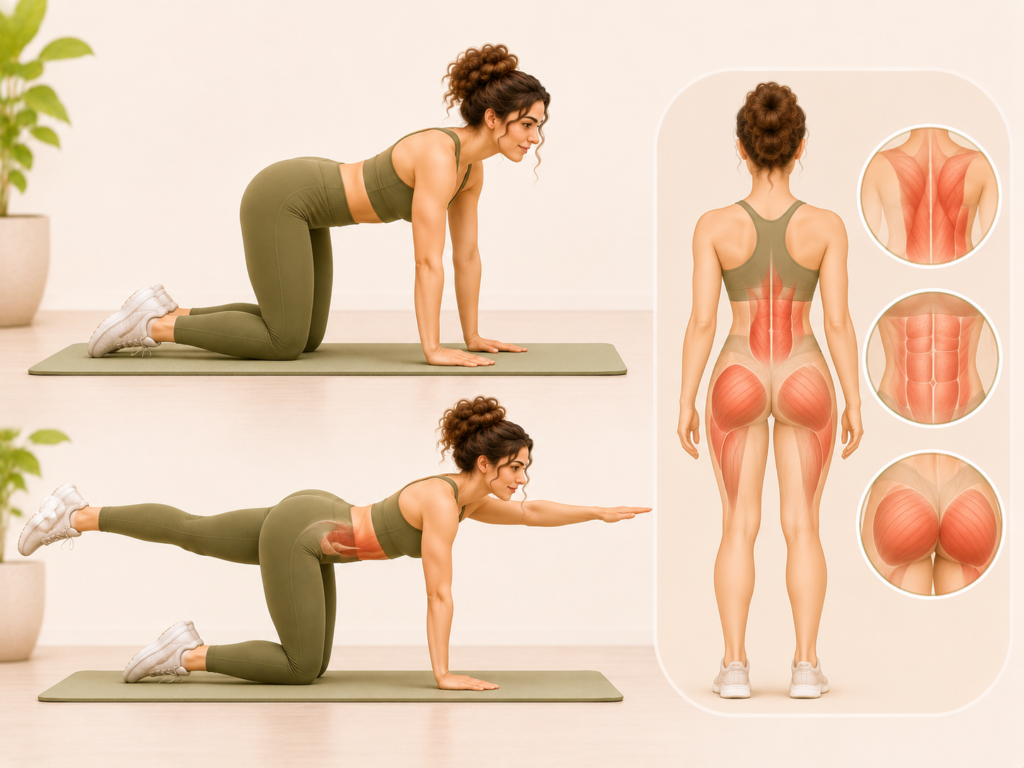
Main purpose: Developing core stability, coordination and trunk control.
Muscles involved: Abdominal stabilisers, spinal erectors, glutes and shoulder stabilisers.
The bird dog is a controlled floor exercise that challenges balance and coordination. It involves extending the opposite arm and leg while keeping the trunk stable.
How to perform a bird dog:
- Begin on your hands and knees on an exercise mat.
- Position your hands beneath your shoulders and knees beneath your hips.
- Keep your back in a comfortable neutral position.
- Gently engage your abdominal muscles.
- Extend your right arm forward while extending your left leg backwards.
- Keep your hips level and avoid rotating your torso.
- Return slowly to the starting position.
- Repeat with the opposite arm and leg.
Beginner recommendation: Start with 5–8 repetitions per side.
Common mistakes to avoid:
- Rotating or dropping the hips.
- Arching the lower back.
- Lifting the leg excessively high.
- Moving too quickly.
- Holding your breath.
Modification: Practise extending only one arm or one leg at a time before attempting the full movement.
7. Standing Calf Raises
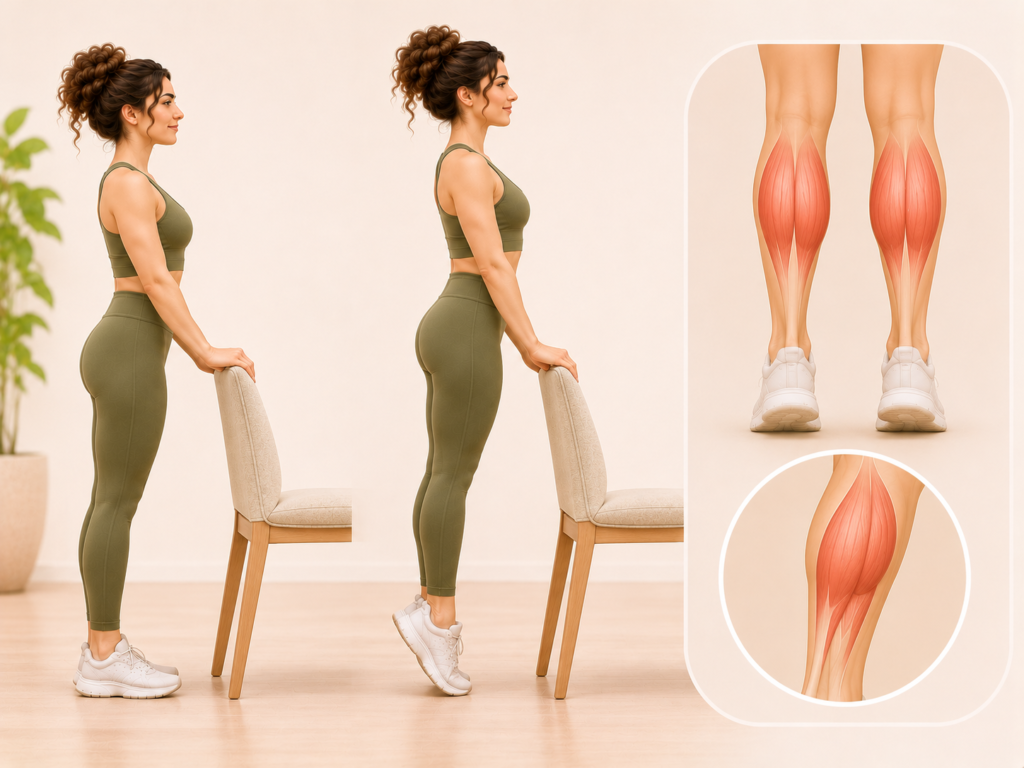
Main purpose: Strengthening the lower legs and practising balance.
Primary muscles: Gastrocnemius and soleus.
Supporting muscles: Ankle stabilisers.
Standing calf raises are a simple bodyweight exercise that can be performed while holding a stable chair for balance.
How to perform standing calf raises:
- Stand behind a sturdy chair and hold it lightly.
- Place your feet approximately hip-width apart.
- Keep your knees relaxed rather than forcefully locked.
- Slowly raise your heels until you are standing on the balls of your feet.
- Pause briefly at the top.
- Lower your heels slowly back to the floor.
- Repeat with control.
Beginner recommendation: Start with 8–12 repetitions.
Common mistakes to avoid:
- Bouncing at the top.
- Leaning heavily on the chair.
- Rolling the ankles outward.
- Moving too quickly.
Modification: Perform smaller heel raises or practise seated calf raises if standing is difficult.
8. Supported Step-Back Lunges
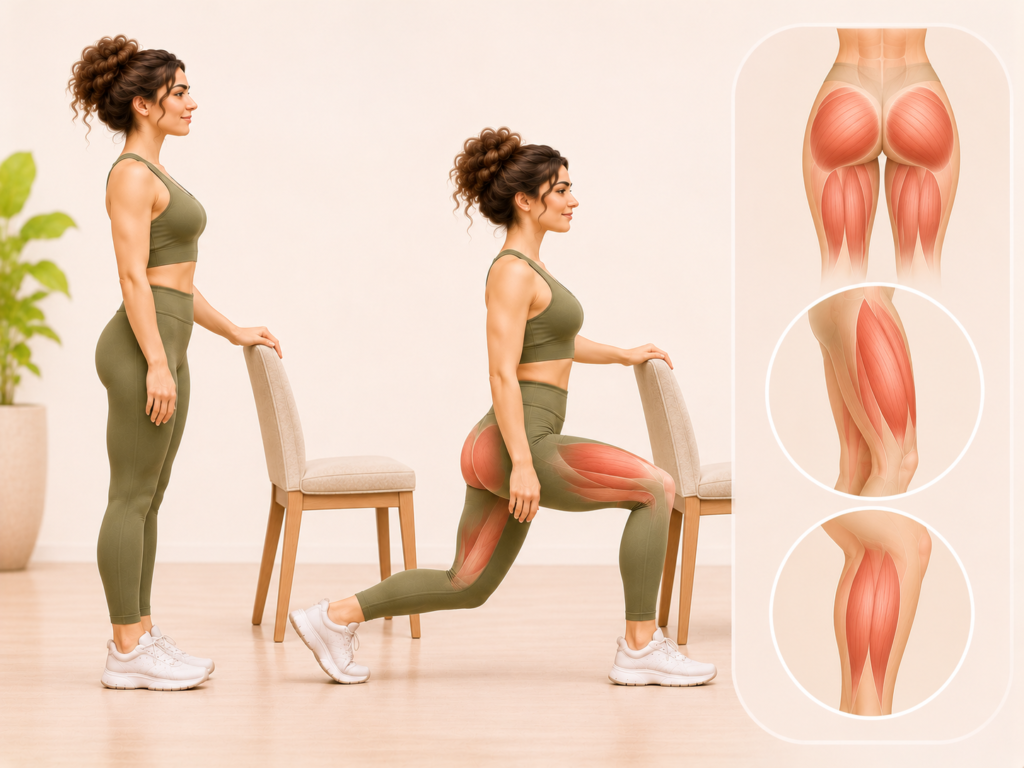
Main purpose: Developing lower-body strength, coordination and balance.
Primary muscles: Quadriceps and gluteus maximus.
Secondary muscles: Hamstrings and core stabilisers.
A supported step-back lunge is a beginner-friendly variation of a reverse lunge. Holding a stable chair can help you maintain balance while practising the movement.
How to perform supported step-back lunges:
- Stand beside or behind a sturdy chair and hold it lightly.
- Place your feet hip-width apart.
- Step one foot backwards while keeping your torso upright.
- Bend both knees slightly as you lower your body.
- Keep the front foot grounded and the front knee aligned with the toes.
- Push through the front foot to return to standing.
- Repeat on the other side.
Beginner recommendation: Start with 5–8 repetitions per side.
Common mistakes to avoid:
- Taking an excessively long step.
- Allowing the front knee to collapse inward.
- Losing balance.
- Dropping the back knee too far.
- Leaning forward excessively.
Modification: Practise a small step-back without lowering deeply. You can also begin with supported split-stance weight shifts.
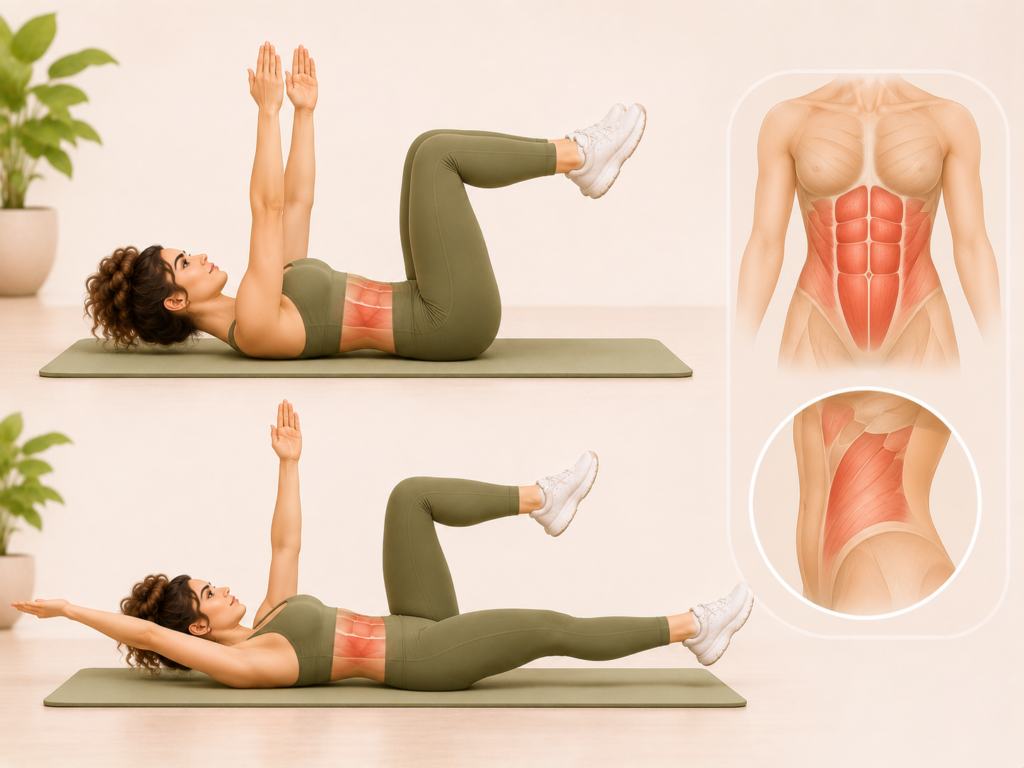
9. Dead Bugs
Main purpose: Developing abdominal strength and core control.
Muscles involved: Deep abdominal stabilisers, rectus abdominis and supporting trunk muscles.
Dead bugs are performed lying on your back. The exercise teaches you to move your arms and legs while maintaining control of your torso.
How to perform dead bugs:
- Lie on your back on an exercise mat.
- Raise your arms towards the ceiling.
- Lift your legs and bend your knees to approximately 90 degrees.
- Gently engage your abdominal muscles.
- Slowly lower your right arm and left leg towards the floor.
- Keep your torso stable and avoid excessive lower-back arching.
- Return to the starting position.
- Repeat with the opposite arm and leg.
Beginner recommendation: Start with 5–8 repetitions per side.
Common mistakes to avoid:
- Moving too quickly.
- Arching the lower back excessively.
- Lowering the arms and legs beyond your control.
- Holding your breath.
- Allowing the ribs to flare upwards.
Modification: Keep both feet on the floor and practise alternating arm movements first. You can also move only one leg at a time.
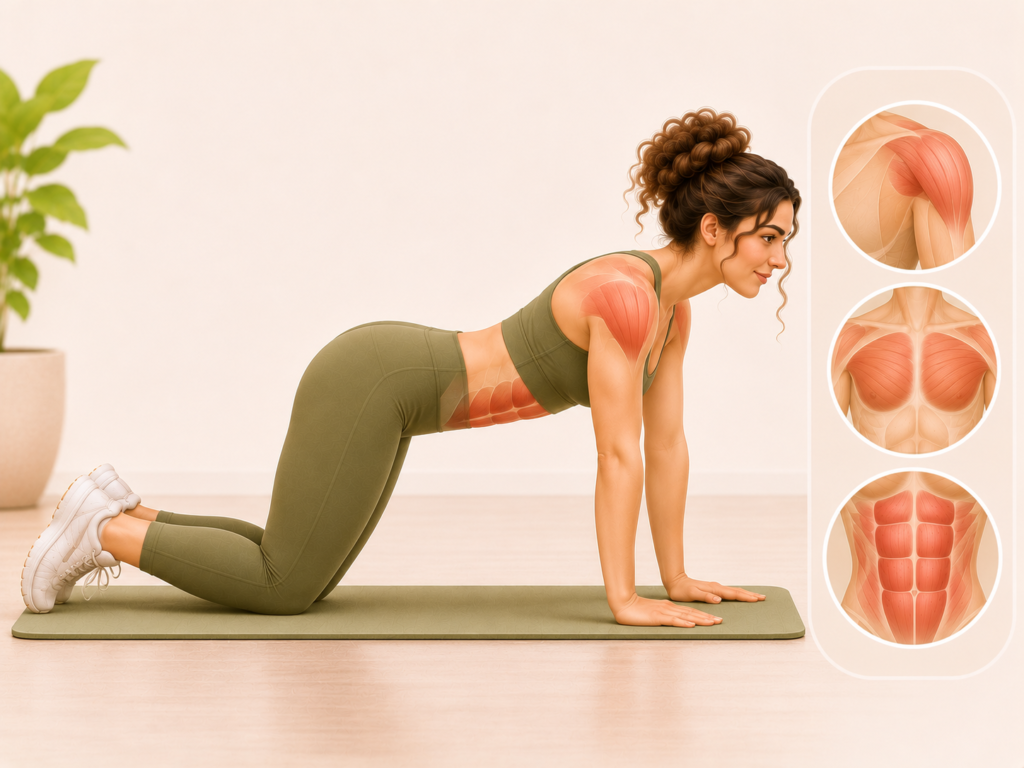
10. Modified Plank
Main purpose: Developing core and upper-body endurance.
Muscles involved: Abdominal muscles, shoulders, chest and supporting trunk stabilisers.
A modified plank performed with the knees on the floor can be a manageable starting point for beginners who are not yet comfortable with a full plank.
How to perform a modified plank:
- Begin on your hands and knees on a mat.
- Position your hands beneath your shoulders.
- Move your knees slightly backwards while keeping them on the floor.
- Align your head, shoulders, hips and knees.
- Gently tighten your abdominal muscles.
- Maintain the position while breathing normally.
- Lower yourself and rest.
Beginner recommendation: Start with 10–20 seconds.
Common mistakes to avoid:
- Allowing the hips to sag.
- Raising the hips excessively.
- Holding your breath.
- Allowing the shoulders to collapse.
- Continuing after you lose proper alignment.
Modification: Begin with a hands-and-knees tabletop hold or a wall plank.
A Simple 20-Minute Home Workout for Beginners
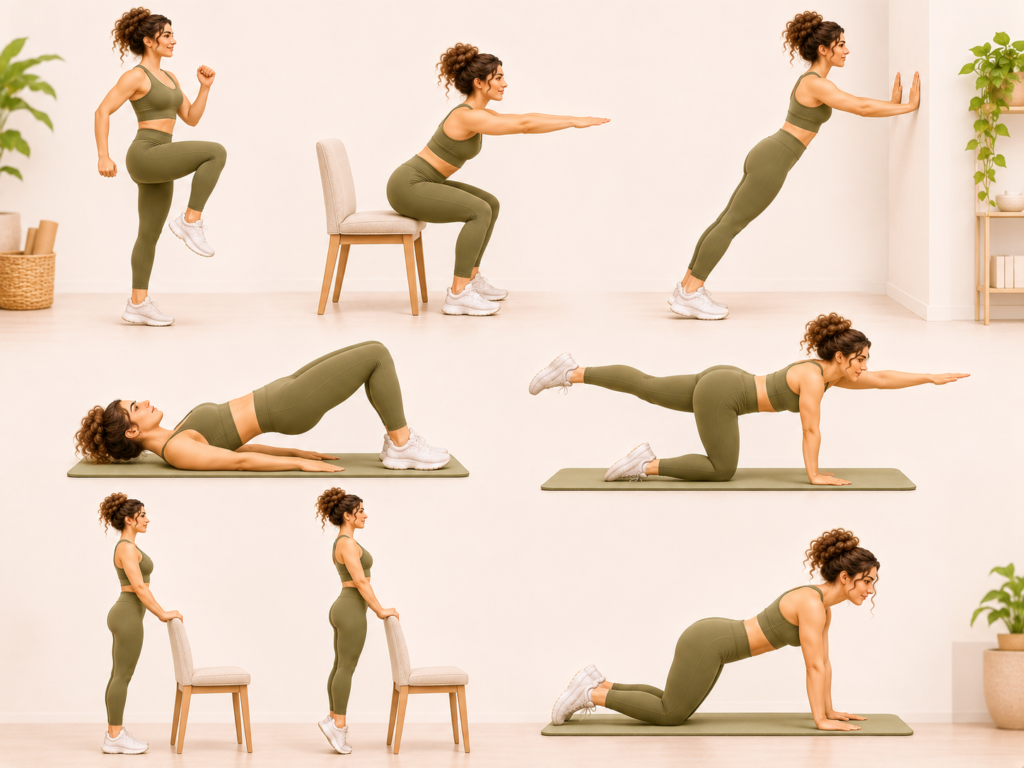
Once you understand the basic movements, you can combine them into a simple full-body home workout.
The following routine is designed as a flexible starting point for adults who are new to exercise. It combines gentle aerobic movement, lower-body exercises, upper-body strength and core stability.
You do not need to complete every movement at maximum intensity. Prioritise correct form and adjust the number of repetitions or duration according to your ability.
Beginner 20-minute workout structure
| Workout stage | Exercise | Suggested duration |
|---|---|---|
| Warm-up | Gentle marching in place | 1 minute |
| Warm-up | Shoulder circles and gentle mobility | 1 minute |
| Warm-up | Easy side steps | 1 minute |
| Main workout | Chair squats | 8–10 reps |
| Main workout | Wall push-ups | 8–10 reps |
| Main workout | Glute bridges | 8–12 reps |
| Main workout | Standing knee raises | 30 seconds |
| Main workout | Bird dogs | 5–8 per side |
| Main workout | Standing calf raises | 10–12 reps |
| Main workout | Supported step-back lunges | 5–8 per side |
| Main workout | Dead bugs | 5–8 per side |
| Main workout | Modified plank | 10–20 seconds |
| Recovery | Rest between exercises and adjust the number of rounds | As needed |
| Cool-down | Gentle stretching and relaxed breathing | 2–3 minutes |
How to use this routine:
- Start with one round of the exercises.
- Take approximately 30–60 seconds of rest when needed.
- Rest longer if you need to recover your breathing or maintain good technique.
- Do not rush to complete the entire routine.
- If the full session feels too challenging, choose four or five exercises and build up gradually.
The total time will vary depending on repetitions, rest periods and individual fitness. Treat 20 minutes as an approximate session target, not a strict requirement.
Your First 4-Week Home Workout Plan
One of the most common beginner mistakes is trying to do too much during the first few days. A more sustainable approach is to build your home workout routine gradually.
The following four-week plan provides a simple progression. It is a flexible example rather than a fixed requirement. Some beginners may need to repeat a week before increasing the challenge.
Week 1: Learn the movements
Main goal: Become familiar with basic exercise technique.
- Choose four or five beginner exercises.
- Start with one comfortable round.
- Use wall push-ups and supported squats if needed.
- Practise controlled breathing.
- Allow sufficient recovery between sessions.
At this stage, consistency and movement quality matter more than completing a long workout.
Week 2: Build consistency
Main goal: Develop a repeatable exercise routine.
- Continue with your selected exercises.
- Aim for two or three manageable sessions if recovery allows.
- Add a few repetitions where comfortable.
- Include gentle walking or other enjoyable daily activity.
- Continue practising proper form.
Week 3: Gradually increase the challenge
Main goal: Improve strength and endurance.
If the movements feel manageable, consider:
- Adding a few repetitions.
- Increasing the duration of marching.
- Performing another round of selected exercises.
- Reducing unnecessary rest only when you can maintain good technique.
Do not increase every part of the workout simultaneously.
Week 4: Improve control and confidence
Main goal: Establish a routine you can maintain.
- Continue your preferred exercises.
- Practise slower, controlled repetitions.
- Choose slightly more challenging variations only if ready.
- Review which movements feel comfortable.
- Plan how to continue exercising in the following month.
Progress is not measured only by how many repetitions you complete. Better balance, improved coordination, greater confidence and more consistent exercise habits are meaningful improvements too.
Weekly Home Workout Schedule for Beginners
A weekly exercise schedule can help you organise your workouts while leaving enough time for recovery.
You do not need to perform intense exercise every day. A balanced routine can combine strength sessions, low-impact aerobic activity, walking and rest.
Here is an example of a beginner-friendly weekly schedule.
| Day | Suggested activity | Main focus |
|---|---|---|
| Monday | Beginner full-body home workout | Strength and coordination |
| Tuesday | 15–20 minutes of comfortable walking | Aerobic activity |
| Wednesday | Rest or gentle mobility | Recovery |
| Thursday | Beginner full-body home workout | Strength and stability |
| Friday | Walking or gentle dancing | Cardiovascular fitness |
| Saturday | Optional short home workout or enjoyable activity | General movement |
| Sunday | Rest or relaxed walking | Recovery |
This is an example, not a mandatory schedule. If you are new to exercise, begin with fewer sessions and build gradually.
How many days a week should a beginner work out?
Many beginners can start with two structured full-body exercise sessions per week, with recovery days between them. Light movement, walking and other comfortable activities can be added on other days.
For general health, adults are advised to work towards at least 150 minutes of moderate-intensity aerobic activity each week and muscle-strengthening activity on at least two days. These are longer-term public-health targets, not a requirement that every beginner must meet immediately.
You can divide aerobic activity into shorter sessions throughout the week. CDC: Adult Physical Activity Guidelines.
Why are recovery days important?
Exercise challenges your body. Recovery gives you time to adapt and prepare for the next session.
A rest day does not mean you must remain completely inactive. Gentle walking and comfortable mobility exercises may be appropriate if you feel well.
However, avoid training through significant pain, unusual exhaustion or symptoms that suggest you need medical attention.
Low-Impact Home Workouts for Beginners
Low-impact exercise is an option for people who prefer movements that do not involve jumping or running. These workouts can be particularly useful when you are building confidence, returning to exercise or looking for a gentler routine.
Low-impact does not necessarily mean low effort. You can still increase your heart rate and challenge your muscles without jumping.
Examples of low-impact exercises
- Marching in place.
- Side steps.
- Chair squats.
- Wall push-ups.
- Standing knee raises.
- Glute bridges.
- Supported calf raises.
- Gentle standing mobility exercises.
- Seated marching.
- Controlled bird dogs.
How to make home workouts easier on your joints
- Begin with a comfortable range of motion.
- Avoid sudden or uncontrolled movements.
- Choose stable surfaces and supportive footwear when appropriate.
- Use a chair or wall for balance if needed.
- Reduce repetitions if your technique begins to deteriorate.
- Allow recovery between challenging sessions.
- Stop if you experience sharp, worsening or unusual pain.
If you have persistent joint pain, a previous injury or a medical condition that affects movement, ask a qualified healthcare professional about appropriate exercise modifications.
Can Home Workouts Help With Weight Loss?
Home workouts can support weight management by increasing physical activity and contributing to overall energy expenditure. However, exercise alone does not guarantee weight loss.
Body weight is influenced by several factors, including food intake, activity levels, sleep, genetics, medications, health conditions and long-term lifestyle habits.
A balanced weight-management approach may include:
- Regular physical activity.
- Strength training to develop and maintain muscle.
- Aerobic activity such as walking or dancing.
- A balanced eating pattern that supports your nutritional needs.
- Adequate sleep and recovery.
- Consistency over time.
Do home workouts burn calories?
Yes. Physical activity uses energy, and the amount depends on several factors, including the type of exercise, duration, intensity, body size and individual movement efficiency.
For example, a brisk indoor marching session may use more energy than a short, gentle stretching session. However, calorie expenditure varies considerably between people, so it is not useful to assign one exact calorie figure to every beginner workout.
Can home workouts reduce belly fat?
Home workouts can help improve overall fitness and support weight management, but exercises targeting the abdomen do not selectively burn fat from the stomach.
Movements such as dead bugs and modified planks strengthen the core muscles. They do not directly remove abdominal fat.
Changes in body fat generally occur through overall energy balance and other individual factors, not through exercising one specific body part.
Is a home workout enough without walking?
A home workout can be an important part of your activity routine, but your overall programme should include enough aerobic activity as well as muscle-strengthening exercise.
You can combine indoor marching, dancing, walking, cycling or other activities you enjoy to increase your weekly movement.
Common Home Workout Mistakes Beginners Should Avoid
Starting a home fitness routine is easier when you know which mistakes can make exercise unnecessarily difficult or uncomfortable.
1. Doing too much too soon
Trying to complete a long, intense workout on your first day can lead to excessive soreness and make it harder to stay consistent.
Start with a manageable routine and increase the challenge gradually.
2. Skipping the warm-up
Beginning a workout with sudden, intense movements may feel uncomfortable, especially if you have been sitting for a long time.
Spend a few minutes with gentle marching, shoulder circles and easy mobility movements before more challenging exercise.
3. Ignoring exercise technique
Correct movement is more important than completing a large number of repetitions.
If your posture becomes unstable, slow down, reduce the range of motion or take a break.
4. Comparing your progress with others
People have different starting fitness levels, movement abilities and recovery needs.
Focus on your own improvements rather than comparing your workout performance with someone else’s.
5. Exercising without recovery
Training the same muscles intensely every day may not give your body enough time to recover.
Include rest or lighter activity between challenging sessions.
6. Expecting immediate physical changes
Fitness improvements take time. You may first notice that movements feel easier, your balance improves or you can complete more repetitions with better control.
These changes are valuable even when your appearance or body weight has not changed.
7. Choosing exercises that are too difficult
A beginner does not need to start with burpees, jump squats, full push-ups or high-intensity interval training.
Choose movements that match your current ability and progress when you can perform them with good control.
How to Stay Consistent With Home Workouts
The most effective beginner workout plan is one that you can maintain. You do not need a perfect routine; you need a realistic one that fits your lifestyle.
Here are some practical ways to stay consistent.
Set a realistic starting goal
Instead of committing to an hour of exercise every day, begin with a shorter session you can comfortably complete.
A 10-minute workout can be a useful starting point.
Schedule your workouts
Choose specific days and times for exercise. Treat your workout as an appointment with yourself.
Keep your workout space ready
A clear area, a mat and a stable chair can make it easier to begin without spending time preparing.
Track your progress
Record the exercises you complete, the number of repetitions and how comfortable each movement feels.
You can also track how regularly you exercise.
Choose movements you enjoy
You are more likely to maintain a routine when you enjoy it. Combine bodyweight exercises with walking, dancing or other activities that make movement enjoyable.
Celebrate consistency
Do not judge progress only by body weight, appearance or workout duration.
Being able to perform a movement with better control or following your schedule more regularly is meaningful progress.
Frequently Asked Questions About Home Workouts for Beginners
A beginner-friendly full-body workout can include chair squats, wall push-ups, glute bridges, marching in place, bird dogs and supported calf raises. Start with a small number of exercises and focus on correct technique.
Yes. Many beginner exercises use bodyweight resistance and require no gym equipment. Squats, wall push-ups, glute bridges, marching in place and bird dogs are examples of movements you can practice at home.
A beginner can start with 10–15 minutes and gradually work towards longer sessions as fitness improves. A 20-minute workout can be a practical goal, but the ideal duration depends on your fitness level, recovery and schedule.
Many beginners can start with two structured strength-focused sessions per week, allowing recovery between them. You can add comfortable walking and other light activities on additional days.
You can be physically active every day, but you do not need to perform a challenging full-body workout daily. Alternate demanding exercise sessions with walking, gentle mobility or recovery days.
A 15-minute home workout can help you practice movement, develop consistency and contribute to your weekly physical activity. Its benefits depend on the exercises, intensity, frequency and your overall activity level.
Home workouts can support weight management by increasing physical activity and energy expenditure. Sustainable weight loss also depends on nutrition, overall energy balance and individual health factors.
Bodyweight exercises can challenge muscles and help beginners develop strength. As you become stronger, you may need to increase the difficulty through additional repetitions, more challenging variations or added resistance.
Marching in place is a simple starting movement for many beginners. Chair squats and wall push-ups are also useful options because they can be adjusted to different ability levels.
There is no universally best time to exercise. Choose a time when you feel comfortable, have enough energy and can maintain a consistent routine.
Conclusion
Starting a home workout routine does not require expensive equipment, complicated exercise or hours of free time. Simple bodyweight movements can help beginners develop strength, coordination, balance and cardiovascular fitness.
Begin with exercises that feel manageable, such as marching in place, chair squats, wall push-ups and glute bridges. Learn the correct technique, allow enough recovery and gradually increase the challenge as your confidence improves.
A short beginner home workout performed consistently can be a meaningful first step towards a more active lifestyle. You do not need to do everything perfectly. Focus on building a routine that feels safe, realistic and sustainable.
Start where you are, move at your own pace and give yourself time to progress.
Medical Disclaimer
This article is intended for general educational purposes and does not replace individual medical advice, diagnosis or treatment. Exercise suitability varies according to age, fitness level, medical history, injuries and other individual circumstances.
If you have a chronic health condition, significant joint or back pain, balance difficulties, a recent injury, or have been inactive for a long time and are unsure how to begin, consult an appropriate healthcare professional before starting a new exercise programme.
Stop exercising if you experience chest pain, faintness, severe or unusual shortness of breath, or other concerning symptoms, and seek appropriate medical attention.
Credible Medical and Fitness References
- UK Chief Medical Officers — Physical Activity Guidelines
https://www.gov.uk/government/publications/physical-activity-guidelines-uk-chief-medical-officers-report/uk-chief-medical-officers-physical-activity-guidelines - NHS — Physical Activity Guidelines for Adults Aged 19 to 64
https://www.nhs.uk/live-well/exercise/physical-activity-guidelines-for-adults-aged-19-to-64/ - NHS — How to Improve Your Strength and Flexibility
https://www.nhs.uk/live-well/exercise/how-to-improve-strength-flexibility/ - CDC — Adult Activity: An Overview
https://www.cdc.gov/physical-activity-basics/guidelines/adults.html - MedlinePlus — Indoor Fitness Routine
https://medlineplus.gov/ency/patientinstructions/000890.htm - NIDDK — Tips for Starting Physical Activity
https://www.niddk.nih.gov/health-information/weight-management/tips-get-active/tips-starting-physical-activity - NHS — Home Workout Videos
https://www.nhs.uk/better-health/get-active/home-workout-videos/
Editorial note: These sources support the general physical-activity recommendations and the value of home exercise. The exercise instructions in this article are general educational guidance, not individualised rehabilitation or medical prescriptions.