

When a couple is having difficulty becoming pregnant, fertility is often thought of primarily as a woman’s health issue. But male fertility is an important part of reproductive health, and male factors can contribute to infertility either alone or together with female factors.
Male infertility can result from problems with sperm production, sperm quality, hormone signaling, the reproductive tract, ejaculation, sexual function, certain medications, genetic conditions, previous illnesses or injuries, and lifestyle or environmental factors.
Importantly, male infertility does not necessarily mean that a man can never father a child.
Some causes are treatable or reversible. In other situations, assisted reproductive technologies can allow sperm to be used to achieve pregnancy even when natural conception is difficult. A proper evaluation is therefore much more useful than assuming that infertility means permanent sterility.
One of the most important first steps in evaluating male fertility problems is a semen analysis. It can assess characteristics such as semen volume, sperm concentration, sperm motility and sperm morphology. However, a semen analysis is not a simple pass-or-fail fertility test. Sperm parameters can vary between samples, and individual results do not by themselves perfectly predict whether a man can achieve a pregnancy.
This guide explains male infertility causes, low sperm count, sperm motility, sperm morphology, semen analysis, male fertility testing, lifestyle factors that can affect sperm health, treatment options and practical ways men can support reproductive health.
What Is Male Fertility?
Male fertility refers to a man’s ability to contribute sperm capable of fertilizing an egg and ultimately contributing to pregnancy.
For this to happen, several biological processes need to work together.
The testes need to produce sperm.
Hormones need to coordinate sperm production.
Sperm need to mature properly.
The reproductive tract needs to transport sperm.
During ejaculation, sperm need to be released into the reproductive tract.
And during intercourse, sperm need to reach the female reproductive tract at an appropriate time.
This means fertility is not determined by sperm count alone.
A man can have a relatively high sperm count but still have fertility problems if sperm movement, sperm structure, ejaculation or another part of the reproductive system is affected.
Likewise, a man with a lower-than-reference sperm concentration may still be capable of achieving a pregnancy.
This is why modern male infertility evaluation looks at the entire reproductive picture rather than relying on a single number.
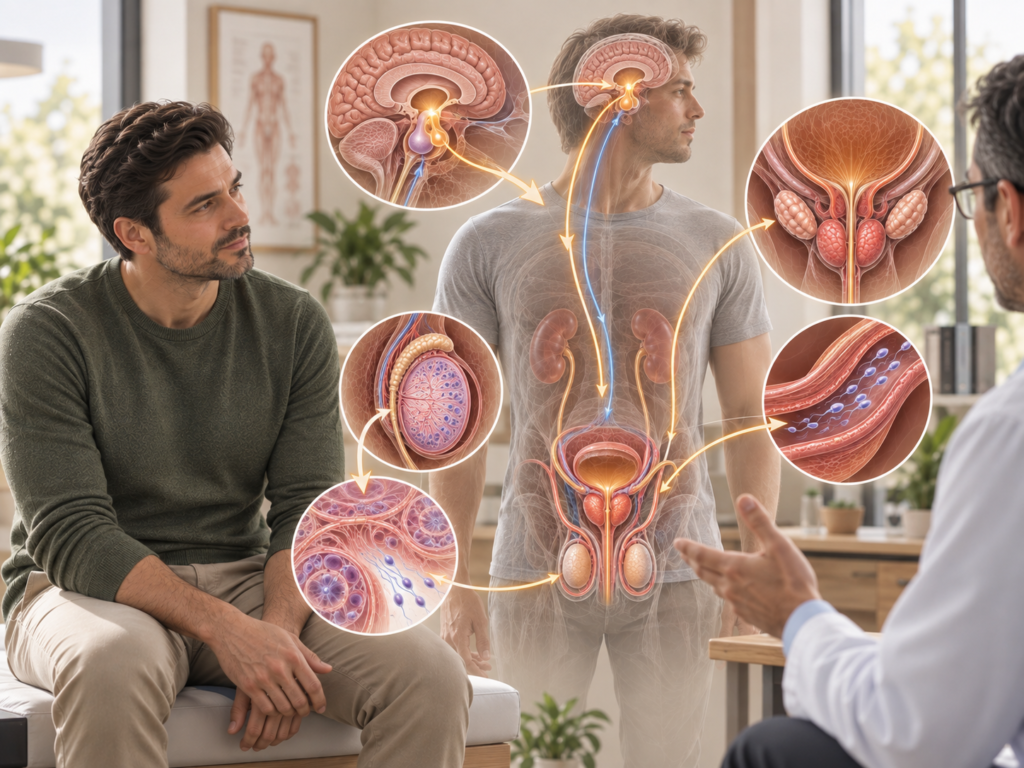
How Male Fertility Works
Understanding how male fertility works makes it easier to understand how infertility can develop.
Step 1: The Brain Signals the Reproductive System
The hypothalamus and pituitary gland in the brain coordinate reproductive hormone signaling.
Hormones including follicle-stimulating hormone (FSH) and luteinizing hormone (LH) help regulate testicular function.
Step 2: The Testes Produce Sperm
Inside the testes are tiny structures called seminiferous tubules where sperm are produced.
Sperm production is called spermatogenesis.
The process requires appropriate hormonal signaling and healthy testicular function.
Step 3: Sperm Mature
Newly produced sperm undergo further maturation as they travel through the reproductive tract, particularly the epididymis.
This maturation process helps sperm develop the ability to move effectively.
Step 4: Sperm Travel Through the Reproductive Tract
During ejaculation, sperm travel through the vas deferens and mix with fluids produced by reproductive glands, including the seminal vesicles and prostate.
The resulting semen carries sperm out of the body.
Step 5: Sperm Must Reach and Fertilize an Egg
For natural conception to occur, sperm must survive within the female reproductive tract, reach an egg and successfully fertilize it.
Problems at any stage of this process can affect male fertility.
What Is Male Infertility?
Male infertility generally refers to difficulty achieving a pregnancy because of factors affecting the male partner.
Infertility is evaluated at the couple level, meaning both partners should generally be assessed when pregnancy is not occurring as expected. Male and female factors can occur independently or together.
Male infertility may involve:
- Low sperm concentration
- Poor sperm motility
- Abnormal sperm morphology
- No sperm in the semen
- Problems producing sperm
- Blockages preventing sperm from entering semen
- Hormonal disorders
- Genetic conditions
- Problems with ejaculation
- Erectile dysfunction
- Testicular conditions
- Certain medications
- Previous surgery or injury
- Lifestyle or environmental exposures
Sometimes a specific cause can be identified.
In other cases, no single explanation is found despite appropriate evaluation.
What Are the Signs of Male Infertility?
One of the most important things to know about male infertility symptoms is that infertility often has no obvious symptoms.
A man can feel completely healthy, have normal sexual desire and erections, and still have abnormal sperm production.
That is why fertility cannot reliably be judged by:
- Libido
- Ejaculation volume
- Sexual performance
- The appearance of semen
- How often a man has sex
- How “healthy” he feels
A semen analysis and appropriate medical evaluation are much more informative.
However, some underlying causes of infertility can produce clues.
Possible signs or associated findings include:
- Difficulty conceiving with a partner
- Erectile dysfunction
- Reduced sexual desire
- Problems with ejaculation
- Testicular pain or swelling
- A lump or abnormality in the testicle
- Small or unusually firm testicles
- Reduced facial or body hair associated with hormonal disorders
- Breast enlargement in some hormonal conditions
- Previous testicular injury or surgery
- History of undescended testicle
- Recurrent reproductive tract infections
These findings do not diagnose infertility on their own.
How Common Is Male Infertility?
Infertility is a reproductive health issue affecting couples around the world.
Male factors can contribute substantially to infertility, either alone or alongside female factors.
Because fertility involves two people, both partners should be evaluated when appropriate rather than automatically placing responsibility on the woman or the man. The AUA/ASRM guideline specifically recommends concurrent evaluation of both partners.
This is particularly important because fertility problems can sometimes reveal underlying health conditions that deserve treatment beyond reproductive concerns.
The AUA/ASRM guideline notes that male infertility evaluation can identify potentially correctable conditions, health-threatening conditions and genetic or hormonal problems that may have implications for the man’s health or future offspring.
10 Common Causes of Male Infertility
There isn’t one single cause of male infertility.
The problem can originate from the testes, hormones, reproductive tract, sexual function, genetics, medications, lifestyle or other health conditions.
1. Low Sperm Count
Low sperm count, medically called oligozoospermia or oligospermia, means the concentration or total number of sperm is below the laboratory’s reference range.
A lower sperm count can reduce the probability that enough sperm will reach an egg.
However, sperm count alone does not determine whether a man can or cannot father a child.
2. Poor Sperm Motility
Sperm motility refers to sperm movement.
For natural conception, sperm need to move effectively through the female reproductive tract.
Reduced motility is sometimes called asthenozoospermia.
A semen analysis evaluates different categories of movement, including progressive movement.
Poor sperm motility can make it more difficult for sperm to reach and fertilize an egg.
3. Abnormal Sperm Morphology
Sperm morphology refers to the size and shape of sperm cells.
Some sperm may have abnormalities involving the head, midpiece or tail.
A lower percentage of normally shaped sperm can be associated with reduced fertility, but morphology should not be interpreted in isolation.
The AUA/ASRM guideline emphasizes that individual semen parameters do not independently provide a simple diagnosis of infertility. The overall pattern and clinical context matter.
4. Varicocele
A varicocele is an enlargement of veins within the scrotum.
Varicoceles are relatively common and may sometimes affect sperm production or testicular function.
Not every varicocele causes infertility, and treatment is not automatically necessary for every man with a varicocele.
When a varicocele is associated with infertility and abnormal semen parameters, a male reproductive specialist may evaluate whether treatment could be beneficial.
5. Hormonal Problems
Sperm production depends on a complex hormonal system involving the brain, pituitary gland and testes.
Disorders affecting reproductive hormones can reduce sperm production.
Potential hormonal problems include abnormalities involving:
- FSH
- LH
- Testosterone
- Prolactin
- Other endocrine signals
Importantly, testosterone therapy can suppress sperm production.
This is particularly important for men who are trying to conceive.
Testosterone replacement therapy should therefore not be started simply because a man is experiencing fertility problems or wants to increase testosterone without discussing reproductive goals with a healthcare professional.

6. Blockages in the Reproductive Tract
A man may produce sperm normally but have difficulty getting sperm into the semen because of a blockage.
This can occur in structures such as the epididymis or vas deferens.
Some blockages are associated with:
- Previous infections
- Surgery
- Injury
- Congenital conditions
- Certain genetic disorders
One example is congenital bilateral absence of the vas deferens, which can be associated with genetic changes involving CFTR.
Depending on the cause, sperm may sometimes be retrieved directly for use with assisted reproductive treatment.
7. Problems With Ejaculation
Sperm production may be normal while ejaculation is impaired.
Examples include:
- Retrograde ejaculation
- Delayed ejaculation
- Anejaculation
- Certain nerve-related problems
With retrograde ejaculation, semen may travel backward into the bladder rather than leaving normally through the urethra.
Certain medications, surgeries, neurological disorders and medical conditions can contribute to ejaculation problems.
8. Erectile Dysfunction
Erectile dysfunction (ED) and infertility are not the same thing.
A man can have normal sperm production but have difficulty having intercourse because he cannot achieve or maintain an erection.
Likewise, a man can have erectile function but significantly abnormal sperm production.
However, ED and male infertility can sometimes share underlying causes, including:
- Diabetes
- Hormonal disorders
- Vascular disease
- Nerve problems
- Certain medications
- Psychological factors
Related LifeMate Guide: [Erectile Dysfunction (ED): Causes, Symptoms, Treatment & When to See a Doctor]
9. Genetic Conditions
Genetic factors can affect sperm production, sperm transport or reproductive development.
Some genetic causes become particularly important when sperm counts are extremely low or sperm are completely absent from semen.
The AUA/ASRM guideline recommends specific genetic evaluation in selected men with primary infertility, particularly those with azoospermia or severe oligozoospermia combined with certain clinical findings.
Genetic testing should therefore be guided by a specialist rather than performed indiscriminately.
10. Testicular Injury, Infection or Previous Surgery
The testes are responsible for sperm production, so conditions affecting them can influence fertility.
Potential factors include:
- Previous testicular injury
- Undescended testicle
- Testicular infection
- Testicular surgery
- Testicular cancer or treatment
- Certain childhood conditions
- Previous chemotherapy or radiation
A detailed reproductive and medical history is therefore an important part of a male fertility evaluation.
Low Sperm Count: What Does It Mean?
A low sperm count means that the concentration or total number of sperm in an ejaculate is below a laboratory’s reference range.
But there is an important distinction between a reference value and a diagnosis of infertility.
The WHO’s sixth edition semen manual provides reference distributions based on men whose partners achieved natural conception within 12 months. For example, the lower fifth-percentile reference values include approximately 16 million sperm per milliliter for concentration and 39 million sperm per ejaculate for total sperm number.
These numbers should not be interpreted as a strict line separating fertile and infertile men.
A man below a reference value may still father a child, while a man above it may still have fertility problems.
This is why doctors consider multiple semen parameters together.
Sperm Motility: Why Movement Matters
Sperm need to move effectively to travel through the female reproductive tract.
A semen analysis may classify sperm according to whether they are:
- Progressively motile
- Non-progressively motile
- Immotile
The WHO sixth edition reports a lower fifth-percentile reference value of approximately 42% total motility and 30% progressive motility among its reference population.
Again, these values are reference limits, not an absolute fertility/infertility boundary.
Sperm motility is only one part of the fertility picture.
Sperm Morphology: Does Shape Matter?
Sperm morphology describes the physical structure and shape of sperm.
A normally formed sperm has an appropriately shaped head, midpiece and tail that support its ability to move and participate in fertilization.
The WHO sixth edition uses a lower fifth-percentile reference value of approximately 4% normal forms using strict morphology criteria.
That number can sound surprisingly low.
But sperm morphology is one of the areas where online fertility information can become misleading.
Having fewer normally shaped sperm does not automatically mean a man is infertile.
Doctors interpret morphology alongside:
- Sperm concentration
- Total sperm number
- Motility
- Semen volume
- Medical history
- Physical examination
- Other fertility factors
The AUA/ASRM guideline emphasizes that individual semen parameters are not highly predictive of fertility when considered alone.

Male Fertility Testing: How Is Male Infertility Diagnosed?
A proper male infertility evaluation usually begins with a reproductive history, medical history and semen analysis.
The AUA/ASRM guideline recommends that the initial male evaluation include a reproductive history and one or more semen analyses. Men with abnormal semen parameters or presumed infertility should then be evaluated by a male reproductive specialist for a more complete assessment and additional testing when indicated.
1. Reproductive History
A doctor may ask about:
- How long the couple has been trying to conceive
- Previous pregnancies
- Previous fertility treatment
- Frequency and timing of intercourse
- Erectile function
- Ejaculation
- Libido
- Previous sexually transmitted infections
- Testicular injuries
- Testicular surgery
- Childhood reproductive conditions
- Medications
- Testosterone use
- Recreational drug use
- Smoking
- Alcohol
- Occupational or environmental exposures
- Family history of infertility
These questions are not meant to judge a patient.
They help identify potentially treatable causes.
2. Semen Analysis
A semen analysis, sometimes called a sperm analysis, is one of the most important first tests in male fertility evaluation.
It can assess:
- Semen volume
- Sperm concentration
- Total sperm number
- Sperm motility
- Sperm morphology
- Other semen characteristics
The WHO provides standardized laboratory procedures intended to improve the quality and comparability of semen analysis.
Why One Semen Analysis May Not Be Enough
Semen parameters can vary considerably between ejaculates.
That means an abnormal first test does not necessarily tell the complete story.
The AUA/ASRM guideline notes that semen parameters are highly variable and recommends obtaining at least two semen analyses, particularly when the first result is abnormal.
This is one reason men should avoid panicking after receiving one abnormal semen report.
3. Hormone Testing
Hormone tests may be appropriate when the medical history, physical examination or semen analysis suggests a hormonal problem.
Tests may include:
- Testosterone
- FSH
- LH
- Prolactin in selected situations
The AUA/ASRM guideline recommends hormonal evaluation in infertile men with findings such as impaired libido, erectile dysfunction, oligozoospermia, azoospermia, small or atrophic testes, or other evidence of hormonal abnormalities.
Hormonal testing is therefore not necessarily the first test for every man with fertility concerns.
4. Physical Examination
A male reproductive specialist may examine:
- Testicular size
- Testicular consistency
- Epididymis
- Vas deferens
- Presence of a varicocele
- Signs of hormonal abnormalities
- Other reproductive structures
A physical examination can sometimes reveal a potentially treatable cause that would not be obvious from a semen analysis alone.
5. Genetic Testing
Genetic testing may be recommended in selected men, particularly those with:
- Azoospermia
- Very severe oligozoospermia
- Certain testicular findings
- Suspected genetic conditions
Testing may include chromosomal analysis or specific genetic tests depending on the suspected cause.
This is particularly important before certain assisted reproductive procedures because some genetic causes of infertility can have implications for offspring.
Can Low Testosterone Affect Male Fertility?
Yes—and this is one of the most important fertility facts for men to understand.
Testosterone and sperm production are related, but taking testosterone is not a fertility treatment.
In fact, external testosterone can suppress the hormonal signals required for sperm production.
When testosterone is supplied from outside the body, the brain may reduce production of LH and FSH. This can decrease stimulation of the testes and significantly reduce sperm production.
In some men, sperm production can become extremely low or even disappear from the semen.
Therefore, a man who is actively trying to conceive should not start testosterone replacement therapy without discussing fertility with a qualified healthcare professional.
This is especially important because a man can have symptoms associated with low testosterone while also having fertility goals that require a different treatment strategy.
Related LifeMate Guide: [Low Testosterone in Men: Symptoms, Causes, Testing & Treatment]
Can Erectile Dysfunction Cause Male Infertility?
Erectile dysfunction and infertility are different conditions.
ED itself does not necessarily mean that sperm production is abnormal.
However, severe erectile dysfunction can make natural conception difficult because intercourse may not be possible or may not occur consistently enough to allow sperm to reach the female reproductive tract.
Likewise, a man can have excellent erectile function but have severely impaired sperm production.
This is why fertility evaluation should consider both sexual function and reproductive function.
Lifestyle Factors That Can Affect Sperm Health
Lifestyle is only one part of male fertility, and changing your lifestyle cannot correct every cause of infertility.
However, certain habits can affect overall reproductive health.
Smoking
Smoking is associated with poorer reproductive health and can negatively affect sperm parameters.
If you smoke, quitting is one of the most meaningful steps you can take for your overall health.
Excessive Alcohol
Heavy alcohol consumption can negatively affect general health and may interfere with reproductive function.
Reducing excessive alcohol intake is therefore sensible for men trying to optimize health and fertility.
Obesity and Metabolic Health
Excess body weight and metabolic disorders can be associated with hormonal changes and impaired reproductive health.
Improving overall metabolic health through sustainable nutrition, physical activity and appropriate medical care may benefit some men.
Anabolic Steroids and Testosterone
Anabolic-androgenic steroids and externally administered testosterone can suppress natural sperm production.
This is particularly important for men who use testosterone or anabolic steroids for muscle growth while simultaneously trying to conceive.
If fertility is a goal, discuss hormone use with a reproductive specialist before making decisions.
Heat Exposure
The testes are located outside the main body cavity partly because sperm production functions best at a temperature slightly below core body temperature.
Prolonged or repeated excessive heat exposure may affect sperm production in some men.
However, not every everyday exposure has a clinically meaningful effect, so men should avoid becoming overly anxious about normal activities.
Poor Sleep and High Stress
Sleep, stress and mental health can influence overall hormonal and metabolic health.
Chronic stress can also affect sexual function and relationship well-being.
Improving sleep and managing stress are sensible components of healthy living, although they should not be presented as a guaranteed treatment for infertility.

How to Improve Male Fertility and Sperm Health
There is no guaranteed “natural fertility booster” that works for every man.
The most effective approach is to identify the underlying cause whenever possible and address modifiable health factors.
Focus on These Foundations
Maintain a healthy weight.
Excess body weight can affect metabolic and hormonal health.
Exercise regularly.
Regular physical activity supports cardiovascular and metabolic health.
Eat a balanced diet.
Prioritize vegetables, fruits, whole grains, legumes, nuts, seeds, fish and other nutrient-rich foods.
Don’t smoke.
Smoking cessation benefits cardiovascular, sexual and reproductive health.
Avoid anabolic steroids and unsupervised testosterone.
External testosterone can suppress sperm production.
Limit excessive alcohol.
Prioritize sleep.
Manage chronic health conditions.
Treat infections and reproductive conditions when identified.
And most importantly:
Don’t delay medical evaluation when infertility persists.
Lifestyle changes can support sperm health, but a man with a varicocele, hormonal disorder, reproductive blockage or genetic condition may need targeted treatment.
How Long Does It Take to Improve Sperm Quality?
This is one of the most common questions men ask after receiving an abnormal semen analysis.
Sperm production is not instantaneous.
New sperm develop through a multi-stage process, meaning changes in health, medication, illness or lifestyle may take time to appear in a semen analysis.
Therefore, don’t expect a major change in sperm count or motility after just a few days of dietary changes.
A doctor may recommend repeating semen analysis after an appropriate interval to evaluate whether sperm parameters have changed.
The exact timeframe depends on the underlying cause and the intervention being used.
Can Male Infertility Be Treated?
Yes.
Male infertility treatment depends entirely on the underlying cause.
Possible approaches include:
Treating Infections
If an infection is identified, appropriate medical treatment may improve reproductive health.
Treating Hormonal Disorders
Some hormonal causes of impaired sperm production can be treated with medications that stimulate the body’s own reproductive hormone pathways.
This is different from simply giving testosterone.
Treating Varicocele
In selected men with infertility and clinically significant varicocele, treatment may be considered.
Correcting Obstructions
Certain reproductive tract blockages may be surgically treated or bypassed depending on their location and cause.
Treating Sexual or Ejaculatory Problems
Erectile dysfunction and ejaculation disorders may have specific treatments that can make natural conception more achievable.
Assisted Reproductive Technology
When natural conception remains difficult, assisted reproductive technologies such as intrauterine insemination (IUI), in vitro fertilization (IVF), or intracytoplasmic sperm injection (ICSI) may be considered depending on the couple’s circumstances.
In some cases, sperm can be surgically retrieved directly from the reproductive tract or testicular tissue for use in assisted reproduction.
The AUA/ASRM guideline emphasizes identifying potentially correctable causes while also considering assisted reproductive options when necessary.
When Should a Man Get a Fertility Test?
A man should consider medical fertility evaluation when a couple has been trying to conceive without success or when there is a known risk factor for impaired fertility.
Earlier evaluation may be appropriate if there is a history of:
- Testicular injury
- Undescended testicle
- Testicular surgery
- Chemotherapy or radiation
- Erectile or ejaculation problems
- Very low libido
- Previous infertility
- Reproductive tract infection
- Varicocele
- Testosterone or anabolic steroid use
- Genetic or hormonal disorders
The AUA/ASRM guideline recommends that men be evaluated alongside their female partners rather than treating male fertility as an isolated issue.

Understanding Your Semen Analysis
A semen analysis can look intimidating because laboratory reports contain several numbers.
The most commonly assessed parameters include:
Semen Volume
This measures the amount of semen produced.
Sperm Concentration
This describes the number of sperm per milliliter of semen.
Total Sperm Number
This estimates the total number of sperm in the entire ejaculate.
Total Motility
This describes the proportion of sperm that are moving.
Progressive Motility
This focuses on sperm moving forward rather than simply moving in place.
Morphology
This assesses the proportion of sperm with normal shape according to the laboratory’s criteria.
Vitality
This evaluates whether sperm are alive.
The WHO sixth edition provides standardized laboratory methods and reference distributions for semen characteristics.
But remember:
A semen analysis is not a simple fertility score.
The AUA/ASRM guideline specifically notes that semen parameters are highly variable and that individual values above or below reference limits do not by themselves establish fertility or infertility.
Doctors interpret the complete result alongside the man’s medical history, physical examination and the fertility status of both partners.
Why Male Infertility Should Not Be Ignored
Male infertility is not simply about whether a couple can become pregnant.
It can sometimes provide important information about a man’s overall health.
Certain causes of impaired sperm production are associated with hormonal, genetic, metabolic or testicular conditions that may deserve medical attention.
The AUA/ASRM guideline specifically emphasizes that evaluating infertile men can identify medical conditions that may otherwise go undiagnosed.
This is one reason fertility evaluation should not be viewed as embarrassing or unnecessary.
A fertility problem can be a reason to investigate health—not a reason for shame.
8 Frequently Asked Questions About Male Fertility
Male infertility often has no obvious symptoms. A man may have normal libido and erections while having a low sperm count or abnormal sperm motility. Difficulty conceiving is often the first sign that fertility evaluation may be needed.
Common causes include low or abnormal sperm production, poor sperm motility, abnormal morphology, varicocele, hormonal disorders, reproductive tract blockages, genetic conditions, testicular injury or disease, ejaculation problems, certain medications and lifestyle factors.
Evaluation usually begins with a reproductive history and semen analysis. Depending on the results, a doctor may recommend physical examination, hormone testing, genetic testing, imaging or other specialized investigations.
The WHO sixth edition reports a lower fifth-percentile reference value of approximately 16 million sperm per milliliter and 39 million sperm per ejaculate among its reference population. These are reference values—not absolute boundaries between fertility and infertility.
Low testosterone can be associated with impaired reproductive function, but treating fertility problems with external testosterone can actually suppress sperm production. Men trying to conceive should discuss testosterone treatment with a reproductive or hormone specialist before starting therapy.
ED and infertility are different conditions. ED can make natural conception difficult when intercourse cannot occur, while a man can have normal erections but abnormal sperm production. Both problems can sometimes share underlying causes.
Healthy habits such as maintaining a healthy weight, exercising, avoiding smoking, limiting excessive alcohol, getting adequate sleep, eating a balanced diet and avoiding unsupervised testosterone or anabolic steroids can support overall reproductive health. However, lifestyle changes cannot correct every cause of infertility.
Yes. Treatment depends on the cause and may include treating infections or hormonal disorders, addressing varicocele or reproductive blockages, treating sexual or ejaculation problems, or using assisted reproductive technologies such as IUI, IVF or ICSI.
Conclusion
Male fertility is an important part of men’s reproductive and overall health.
Infertility does not automatically mean permanent sterility, and it should never be treated as something for which a man should feel ashamed.
Problems with sperm production, sperm count, motility or morphology can contribute to difficulty conceiving, but male infertility can also result from hormonal disorders, varicocele, reproductive tract blockages, genetic conditions, sexual dysfunction, medications, previous illness or injury and other health factors.
A semen analysis is one of the most important initial tools for evaluating male fertility, but one abnormal result does not necessarily mean that a man is infertile. Sperm parameters can vary between samples, and fertility depends on the overall reproductive picture.
Men should also be particularly careful with testosterone therapy. Although testosterone is an important male hormone, external testosterone can suppress sperm production, making it an inappropriate fertility treatment for men who are trying to conceive.
The most effective approach to male fertility problems is to identify the underlying cause whenever possible.
If pregnancy has not occurred despite appropriately timed attempts, or if there are risk factors such as testicular problems, erectile or ejaculation difficulties, previous reproductive surgery, testosterone use or known hormonal abnormalities, a medical evaluation can provide answers and open the door to appropriate treatment.
Male fertility is not simply about sperm count.
It is about the health of the brain, hormones, testes, reproductive tract, sexual function and the man as a whole.
Medical Disclaimer
This article is provided for general educational and informational purposes only and does not replace professional medical advice, diagnosis or treatment.
Male infertility can have many different causes, and information in this article cannot determine whether a particular person is fertile or infertile.
If you and your partner are having difficulty conceiving, speak with a qualified healthcare professional or male reproductive specialist. Both partners may need evaluation because infertility can involve male factors, female factors or a combination of both.
Do not start testosterone replacement therapy, anabolic steroids, fertility medications or supplements specifically for fertility without appropriate medical guidance.
Semen analysis results should be interpreted by a qualified healthcare professional. A value outside a laboratory’s reference range does not automatically prove infertility, and a result within the reference range does not guarantee fertility.
Sources & References
1. World Health Organization (WHO)
WHO Laboratory Manual for the Examination and Processing of Human Semen, 6th Edition.
Provides standardized methods and reference distributions for semen analysis.
2. American Urological Association (AUA) & American Society for Reproductive Medicine (ASRM)
Diagnosis and Treatment of Infertility in Men: AUA/ASRM Guideline.
Guidance on male infertility evaluation, semen analysis, hormonal assessment, genetic testing and treatment.
3. American Society for Reproductive Medicine (ASRM)
Diagnosis and Treatment of Infertility in Men: AUA/ASRM Guideline Part I.
Evidence-based guidance for evaluation of male infertility.
4. WHO Human Reproduction Programme
Updated guidance on semen laboratory testing and standardized assessment of male reproductive health.