

If you have polycystic ovary syndrome (PCOS) and are trying to understand your menstrual cycle, one question can be especially frustrating:
“How do I know if I’m actually ovulating?”
PCOS can make ovulation unpredictable. Some people with PCOS ovulate regularly, while others ovulate less frequently or may go through cycles in which ovulation does not occur.
That can make fertility tracking confusing.
You may notice cervical mucus changes, use an ovulation predictor kit, track your basal body temperature, or rely on a fertility app – yet still be unsure whether ovulation actually happened.
The good news is that there are several ways to track and confirm ovulation with PCOS.
Understanding the difference between a possible sign of ovulation and a reliable confirmation can make cycle tracking much more useful.
In this guide, we’ll explain:
- What ovulation is
- How PCOS can affect ovulation
- Signs you may be ovulating with PCOS
- How to track ovulation at home
- How ovulation predictor kits work
- Why LH tests can sometimes be confusing with PCOS
- How basal body temperature can help
- How cervical mucus changes around ovulation
- How doctors can confirm ovulation
- When to seek medical advice
Important: Ovulation symptoms alone cannot reliably confirm that an egg was released. If you need to know whether you’re ovulating , particularly because you’re trying to conceive , a healthcare professional can recommend appropriate testing.

What Is Ovulation?
Ovulation is the release of a mature egg from an ovary.
During a typical menstrual cycle, hormonal signals stimulate a follicle in the ovary to develop.
As the follicle matures, hormonal changes eventually trigger the release of an egg.
After ovulation, the egg can potentially be fertilized if sperm are present in the reproductive tract.
The period around ovulation is therefore particularly important for people who are trying to become pregnant.
But ovulation isn’t necessarily easy to predict in people with PCOS.
How Does PCOS Affect Ovulation?
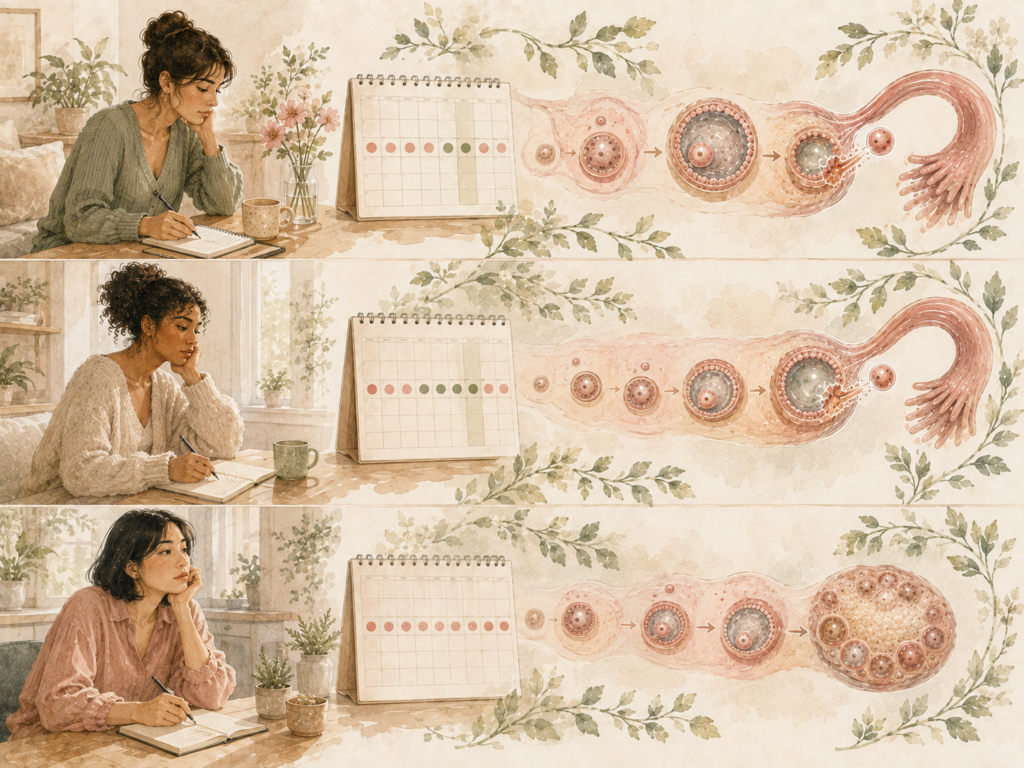
One of the defining reproductive features of PCOS is irregular ovulation.
PCOS can interfere with the hormonal signals responsible for normal follicle development and egg release.
Instead of one follicle consistently developing and ovulating during each cycle, follicle development may become irregular.
As a result, someone with PCOS may:
- Ovulate later than expected.
- Have long menstrual cycles.
- Have unpredictable ovulation.
- Ovulate only occasionally.
- Have some cycles without ovulation.
- Have periods that are difficult to use as an ovulation calendar.
WHO identifies abnormal ovulation as one of the major reproductive features associated with PCOS and describes PCOS as a leading cause of anovulation.
This is why a simple “day 14 ovulation” rule may not work for someone with PCOS.
Can You Ovulate With PCOS?
Yes.
Having PCOS does not automatically mean that you never ovulate.
Some people with PCOS continue to ovulate, although their timing may be less predictable.
Others may ovulate only during some menstrual cycles.
This distinction is important.
You can have PCOS and still ovulate naturally.
You can also have regular-looking bleeding without necessarily knowing whether ovulation occurred.
And if you are trying to conceive, identifying whether and when ovulation occurs can provide useful information for fertility planning.
What Are the Signs of Ovulation With PCOS?
Some physical changes can occur around ovulation.
However, these signs are clues rather than proof that ovulation has occurred.
This distinction is especially important with PCOS because hormonal patterns can sometimes produce changes that resemble ovulation even when egg release has not been confirmed.
Possible signs include:
- Changes in cervical mucus
- A rise in basal body temperature after ovulation
- Mild pelvic or lower-abdominal sensations
- Changes in libido
- Breast tenderness
- Feeling bloated
- Changes in energy or mood
Not everyone experiences these symptoms.
And some people experience them for reasons unrelated to ovulation.
Let’s look at the most useful signs individually.
1. Changes in Cervical Mucus
One of the most noticeable changes around ovulation can occur in cervical mucus.
As estrogen rises before ovulation, cervical mucus may become:
- Clearer
- Wetter
- More slippery
- Stretchy
- Similar in texture to raw egg white
This type of mucus can help sperm move through the reproductive tract.
For someone tracking fertility, noticing increasingly wet and slippery cervical mucus can indicate that the fertile part of the cycle may be approaching.
However, cervical mucus alone cannot prove that ovulation occurred.

2. A Rise in Basal Body Temperature
Another method of tracking ovulation is basal body temperature (BBT).
Your basal body temperature is your body’s resting temperature, measured immediately after waking and before getting out of bed or doing other activities.
After ovulation, hormonal changes—particularly increased progesterone—can cause a small rise in resting body temperature.
When tracked consistently, this temperature shift can provide evidence that ovulation may already have occurred.
This makes BBT different from an ovulation predictor kit.
An LH test can suggest that ovulation may be approaching.
BBT generally helps identify a pattern after ovulation has occurred.
3. Mild Pelvic Pain or Ovulation Pain
Some people experience mild pelvic discomfort around the time of ovulation.
This is sometimes called mittelschmerz.
It may occur on one side of the lower abdomen and can last from a short period to several hours, although experiences vary.
However, pelvic pain is not a reliable way to confirm ovulation.
Many other conditions can cause pelvic pain.
If pain is severe, persistent, sudden, or accompanied by heavy bleeding, fever, fainting, vomiting, or other concerning symptoms, seek medical evaluation rather than assuming it is ovulation pain.
4. Changes in Libido
Some people notice an increase in sexual desire around the fertile part of their cycle.
Hormonal fluctuations may contribute to this change.
However, libido is highly individual and can also be affected by:
- Stress
- Sleep
- Relationship factors
- Medications
- Mental health
- General health
Therefore, changes in sex drive should be considered a possible accompanying sign, not a dependable ovulation test.
5. Breast Tenderness, Bloating or Mood Changes
Some people notice temporary breast tenderness, bloating, mood changes, or other physical sensations around different parts of their menstrual cycle.
These symptoms can occur around ovulation, but they are not specific enough to confirm it.
This is particularly important with PCOS, where hormonal fluctuations may be less predictable.
Which Ovulation Signs Are Most Useful With PCOS?
If you’re trying to track ovulation with PCOS, it’s usually more useful to combine information from multiple methods rather than relying on one symptom.
For example:
Cervical mucus changes
↓
May indicate that your fertile window is approaching
LH testing
↓
May detect an LH rise before ovulation
Basal body temperature
↓
Can show a sustained temperature shift after ovulation
Medical testing
↓
Can provide stronger confirmation when clinically indicated
This layered approach can give you a much clearer picture of your cycle.

How to Track Ovulation With PCOS
Tracking ovulation can be more complicated when you have PCOS because your cycles may not follow a predictable pattern.
A standard calendar may tell you when your period is expected, but it cannot always tell you when—or whether—you ovulated.
That’s why people with PCOS may benefit from combining several fertility-awareness methods rather than relying on a single app, symptom, or test.
Common ways to track ovulation include:
- Menstrual-cycle tracking
- Cervical mucus observation
- Basal body temperature tracking
- Urine ovulation predictor kits
- Fertility-monitoring devices
- Blood progesterone testing
- Ultrasound monitoring
At-home methods can provide useful clues, but medical testing may be needed when you need stronger confirmation of ovulation.
1. Track Your Menstrual Cycle
Start by recording the first day of every menstrual period.
You can use:
- A paper calendar
- A period-tracking app
- A fertility journal
- A digital health tracker
Record:
- First day of bleeding
- Number of bleeding days
- Cervical mucus changes
- Possible ovulation symptoms
- LH test results
- Basal temperature
- Medications
- Pregnancy tests when relevant
Over several cycles, you may begin to see patterns.
However, cycle tracking alone cannot confirm ovulation.
This is particularly important with PCOS because long or irregular cycles can make calendar-based predictions unreliable.
2. Track Cervical Mucus
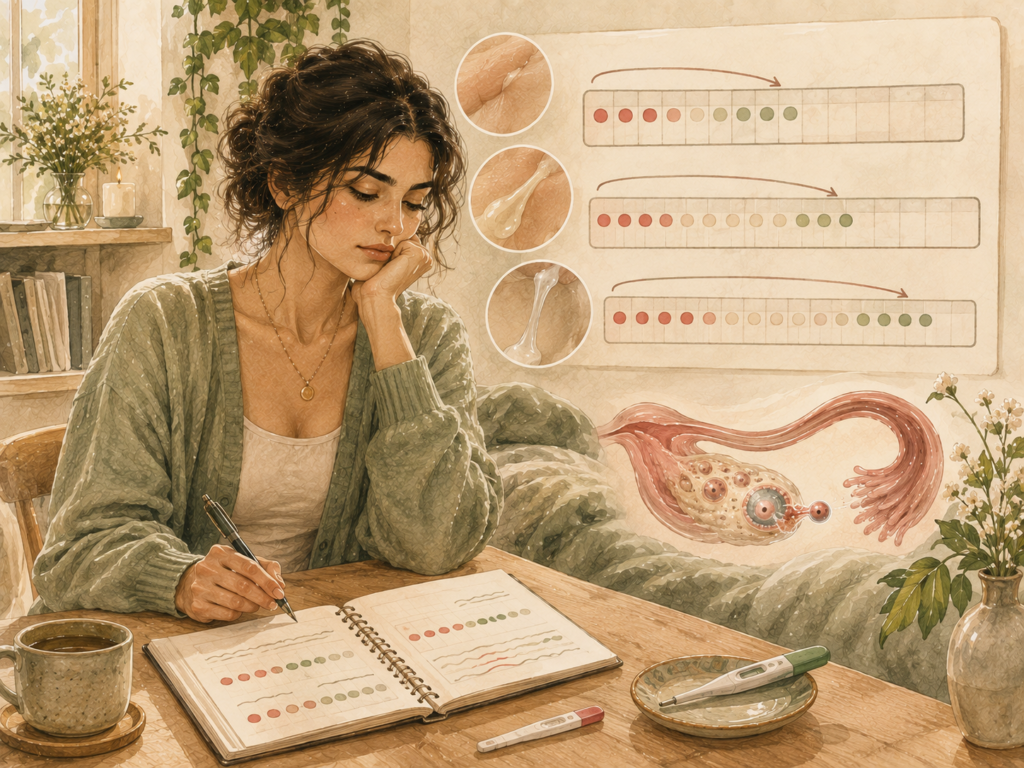
Cervical mucus can change as hormone levels change throughout the menstrual cycle.
Before ovulation, rising estrogen can cause cervical mucus to become increasingly wet, clear, slippery, and stretchy.
This may indicate that the fertile window is approaching.
One practical approach is to pay attention to the sensation and appearance of cervical mucus throughout the day.
For example, you may notice a progression from:
Dry or relatively little mucus → creamy or sticky mucus → wetter/slippery mucus → clear, stretchy mucus
The most fertile-type mucus is often described as resembling raw egg white.
But remember:
Seeing fertile-type cervical mucus does not prove that ovulation occurred.
It is a sign that hormonal changes associated with the fertile phase may be happening.
3. Use Basal Body Temperature
Basal body temperature, or BBT, can provide another piece of information.
Take your temperature immediately after waking, ideally before:
- Getting out of bed
- Eating
- Drinking
- Exercising
- Talking extensively
Try to measure it at approximately the same time each morning.
After ovulation, progesterone generally causes a small increase in resting body temperature.
If you see a sustained temperature shift following lower temperatures earlier in the cycle, that pattern can provide evidence that ovulation probably occurred.
The important limitation:
BBT usually confirms ovulation retrospectively rather than predicting it.
In other words, you may see the temperature rise after the egg has already been released.
That makes BBT particularly useful when combined with other methods.

4. Try an Ovulation Predictor Kit
Ovulation predictor kits, commonly called OPKs, are urine tests designed to detect luteinizing hormone (LH).
A rise in LH usually occurs shortly before ovulation.
In many people, detecting an LH surge can indicate that ovulation may happen within approximately the next day or two.
OPKs can therefore be useful for identifying a potentially fertile period.
But PCOS introduces an important complication.
Why Can Ovulation Tests Be Confusing With PCOS?
Some people with PCOS have elevated or irregular LH levels even when ovulation is not about to occur.
This can make urine LH tests harder to interpret.
You might experience:
- Repeated positive tests
- Several LH surges during one cycle
- Positive results without confirmed ovulation
- Difficulty identifying one clear surge
ASRM notes that people with PCOS may have chronically elevated baseline LH, which can contribute to false-positive urinary LH results.
That doesn’t mean OPKs are useless if you have PCOS.
It means you should avoid treating a positive LH test as absolute proof that ovulation happened.
Combining an LH test with cervical mucus observations and subsequent BBT changes may provide more useful information.

Should You Use an Ovulation App With PCOS?
Period and fertility apps can be useful for organizing your information.
They can help you record:
- Period dates
- Cycle length
- Symptoms
- Cervical mucus
- Temperature
- LH test results
However, an app’s predicted ovulation date is only an estimate.
This matters particularly when cycles are irregular.
If your cycle varies significantly from month to month, an algorithm may have difficulty accurately predicting when you will ovulate.
ACOG notes that home fertility-prediction tools may not work well for everyone, particularly people with highly irregular periods.
So use an app as a record-keeping tool, not as definitive proof of ovulation.
What Is the Best Way to Track Ovulation With PCOS?
There isn’t one perfect method for everyone.
A practical approach is to combine several signals.
At home:
Cycle tracking
Helps you understand your overall pattern.
↓
Cervical mucus
May indicate that the fertile phase is approaching.
↓
LH testing
May detect an LH surge.
↓
Basal body temperature
Can provide evidence of a temperature shift after ovulation.
↓
Medical testing when necessary
Can provide stronger confirmation.
This is especially useful if you’re trying to conceive and your cycles are highly unpredictable.

When Home Ovulation Tracking Isn’t Enough
Home tracking can be helpful, but there are situations where professional evaluation makes more sense.
Consider talking with a healthcare professional if:
- Your periods are very irregular.
- You go for long periods without menstruating.
- You repeatedly receive confusing LH-test results.
- You’re unsure whether you’re ovulating.
- You’re trying to conceive and haven’t become pregnant.
- Your cycle suddenly changes.
- You develop new or worsening symptoms.
- Tracking your cycle is becoming stressful or overwhelming.
If your cycles are highly irregular, repeatedly trying to predict ovulation at home may become frustrating and inaccurate. Professional evaluation can help determine whether ovulation is occurring and whether treatment is needed.
Can You Have a Period Without Ovulating?
Yes.
Bleeding does not always prove that ovulation occurred.
With PCOS, irregular hormonal patterns can sometimes result in bleeding without a typical ovulatory cycle.
This is one reason why simply counting menstrual days may not be enough if your goal is to determine whether you’re ovulating.
If knowing whether you are ovulating is important—for example, because you’re trying to conceive—your healthcare professional can recommend more objective testing.
Can You Ovulate With PCOS and Still Have Irregular Periods?
Yes.
PCOS can produce unpredictable ovulation.
You may ovulate in some cycles and not others, or ovulate later than expected.
This means that an irregular period does not automatically mean you never ovulate.
At the same time, having occasional signs that look like ovulation does not guarantee that an egg was released.
That’s why tracking becomes more useful when you understand the difference between:
Possible ovulation signs
and
Evidence that ovulation actually occurred.
How Can a Doctor Confirm Ovulation?
Home ovulation tracking can provide useful clues, but if you need to know whether ovulation actually occurred, a healthcare professional can use additional methods.
This can be particularly helpful when you have PCOS and irregular cycles, because predicting ovulation from cycle dates or symptoms alone can be difficult.
Depending on your situation, your clinician may consider:
- Your menstrual history
- Blood progesterone testing
- Ultrasound monitoring
- Other hormone tests when clinically indicated
- A broader fertility evaluation if you are trying to conceive
A history of very infrequent or absent periods can itself strongly suggest that ovulation is not occurring regularly and may prompt evaluation for the underlying cause.
Progesterone Blood Test for Ovulation
A progesterone blood test can provide objective evidence that ovulation recently occurred.
Progesterone normally rises after ovulation because the cells remaining from the ovulated follicle form the corpus luteum and produce progesterone.
Timing matters.
Rather than automatically testing on a particular “day 21,” the American Society for Reproductive Medicine recommends that progesterone generally be measured about one week before the expected start of the next menstrual period when used to assess ovulation.
A progesterone level above 3 ng/mL provides presumptive evidence of recent ovulation according to ASRM, although a single measurement cannot assess the overall quality of the luteal phase because progesterone levels can fluctuate substantially.
Your clinician should interpret the result in the context of your cycle and symptoms.

Ultrasound Monitoring of Ovulation
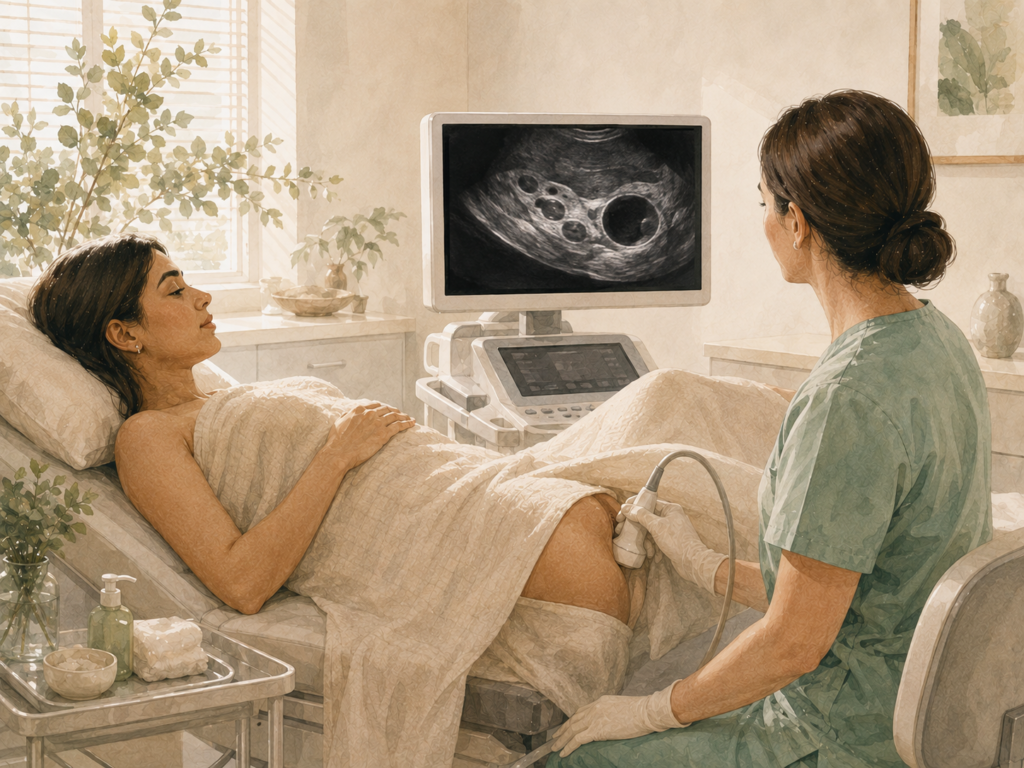
A healthcare professional may also use transvaginal ultrasound to monitor follicle development.
During a monitored cycle, ultrasound can show changes in the ovaries as follicles develop.
Later in the cycle, ultrasound findings may provide evidence consistent with follicle rupture and ovulation.
Ultrasound may be particularly useful during fertility treatment because clinicians can monitor follicle development and make treatment decisions based on what is happening in the ovaries.
However, ultrasound isn’t necessary for everyone who wants to know whether they ovulate.
The appropriate approach depends on your symptoms, cycle pattern, fertility goals, and clinical situation.
Does Having Regular Periods Mean You Are Definitely Ovulating?
Not necessarily.
Regular, predictable menstrual cycles are generally associated with ovulation, but menstrual bleeding alone isn’t an absolute guarantee that ovulation occurred in every cycle.
This is particularly important when evaluating fertility.
ASRM notes that menstrual history can often be enough to establish an ovulatory pattern, while additional testing may be considered when the history is unclear.
If you have regular periods but have other reasons to suspect ovulatory problems, discuss them with your healthcare professional.
PCOS Ovulation and Getting Pregnant
Ovulation is central to natural conception because an egg needs to be released from the ovary for fertilization to occur.
Because PCOS can cause irregular or absent ovulation, some people with PCOS may have fewer opportunities to conceive during a given period of time.
But PCOS does not mean you cannot become pregnant.
Many people with PCOS conceive naturally, while others benefit from treatment that helps restore or induce ovulation. ACOG notes that PCOS is a common cause of infertility but that treatments are available to help people who are trying to become pregnant.
If infertility is caused by anovulation associated with PCOS and there are no other infertility factors, the 2023 international evidence-based PCOS guideline recommends letrozole as the first-line pharmacological treatment for ovulation induction.
This medication should only be used under appropriate medical supervision.
When Should You See a Doctor About PCOS Ovulation?
Consider making an appointment if:
- Your periods are consistently very irregular.
- You frequently go several months without a period.
- You cannot determine whether you’re ovulating.
- You repeatedly get confusing or positive LH-test results.
- You’re trying to conceive and aren’t becoming pregnant.
- Your menstrual pattern has changed significantly.
- You have symptoms suggesting another hormonal condition.
- You’re concerned about your fertility.
You don’t need to spend months trying increasingly complicated home-testing methods if your cycles are very irregular.
A healthcare professional can help determine whether you are ovulating and investigate why your cycles are irregular.
When Should You Seek Urgent Medical Care?
PCOS itself usually does not cause an emergency.
However, don’t automatically attribute severe symptoms to PCOS or ovulation.
Seek urgent medical assessment for symptoms such as:
- Sudden severe pelvic or abdominal pain
- Fainting
- Severe weakness
- Heavy vaginal bleeding
- Severe shortness of breath
- Chest pain
- Severe or persistent vomiting
- A positive pregnancy test accompanied by significant pain or bleeding
These symptoms can have causes that require prompt medical evaluation.
Frequently Asked Questions About PCOS Ovulation
Yes. PCOS can cause irregular or absent ovulation, but it does not necessarily stop ovulation completely. Some people with PCOS ovulate regularly, while others ovulate less frequently or unpredictably.
Possible signs include wetter, clearer and more stretchy cervical mucus, a sustained rise in basal body temperature after ovulation, mild pelvic discomfort, and changes in libido. However, these signs cannot reliably prove that ovulation occurred.
You can track several signals, including cervical mucus, basal body temperature and LH tests. If you need confirmation, a healthcare professional may use appropriately timed progesterone testing or ultrasound monitoring.
Yes. Some people with PCOS have elevated baseline LH, which can make urine LH tests more difficult to interpret and can result in false-positive results
There is no single best home test for everyone with PCOS. LH tests, cervical mucus observations and basal temperature can each provide different information. If home testing is unclear, medical testing such as progesterone measurement or ultrasound may provide stronger evidence of ovulation.
Not necessarily. Fertile-type cervical mucus can indicate hormonal changes associated with the fertile phase, but it does not prove that an egg was released.
No. A positive LH test indicates an LH rise, which usually occurs before ovulation, but it is indirect evidence. With PCOS, elevated baseline LH can make interpretation more difficult.
Yes. Vaginal bleeding can occur without a typical ovulatory cycle. If your periods are very irregular or you frequently go long periods without bleeding, your healthcare professional can evaluate whether you are ovulating normally.
No. PCOS can make conception more difficult when ovulation is irregular, but many people with PCOS become pregnant naturally or with fertility treatment.
Depending on the situation, doctors may use menstrual history, appropriately timed progesterone testing, or ultrasound monitoring. The best method depends on your cycle pattern and reason for evaluation.
Irregular ovulation can make pregnancy more difficult and may also contribute to prolonged gaps between periods. PCOS-related anovulation can be managed with individualized treatment, particularly when pregnancy is desired.

The Bottom Line
PCOS can make ovulation unpredictable, but it does not necessarily prevent ovulation.
If you’re trying to understand your cycle, look at the whole picture rather than relying on one symptom or test.
Cervical mucus may provide clues about approaching fertility.
LH tests may identify an LH surge, but they can be harder to interpret with PCOS.
Basal body temperature may show a pattern consistent with ovulation after it has occurred.
And when you need stronger confirmation, appropriately timed progesterone testing or ultrasound monitoring can provide additional evidence.
Most importantly, don’t assume that an irregular cycle means you cannot become pregnant.
If you’re concerned that you aren’t ovulating, or you’re trying to conceive without success, a healthcare professional can help determine what’s happening and discuss appropriate treatment options.
Medical Disclaimer
This article is intended for general educational purposes and is not a substitute for individualized medical advice, diagnosis, or treatment.
PCOS can affect people differently, and symptoms that resemble ovulation can have other causes.
Do not start fertility medications, hormones, supplements, or other treatments based solely on information in this article.
If you are trying to conceive, have very irregular or absent periods, or are concerned about ovulation, speak with a qualified healthcare professional.
Sources & References
1. World Health Organization — Polycystic Ovary Syndrome
WHO’s January 2026 fact sheet identifies abnormal ovulation as a major feature of PCOS and describes PCOS as the most common cause of anovulation globally.
2. American Society for Reproductive Medicine — Fertility Evaluation of Infertile Women
Provides evidence-based information about evaluating ovulation, including menstrual history, progesterone testing, LH testing, ultrasound and basal body temperature.
3. American College of Obstetricians and Gynecologists — PCOS
Provides patient guidance on PCOS symptoms, irregular periods, infertility and available treatments.
4. 2023 International Evidence-Based Guideline for PCOS
Provides international recommendations for PCOS management, including ovulation induction for infertility associated with anovulatory PCOS.